
Why I Wrote a Guided Journal for Anxious Hearts?
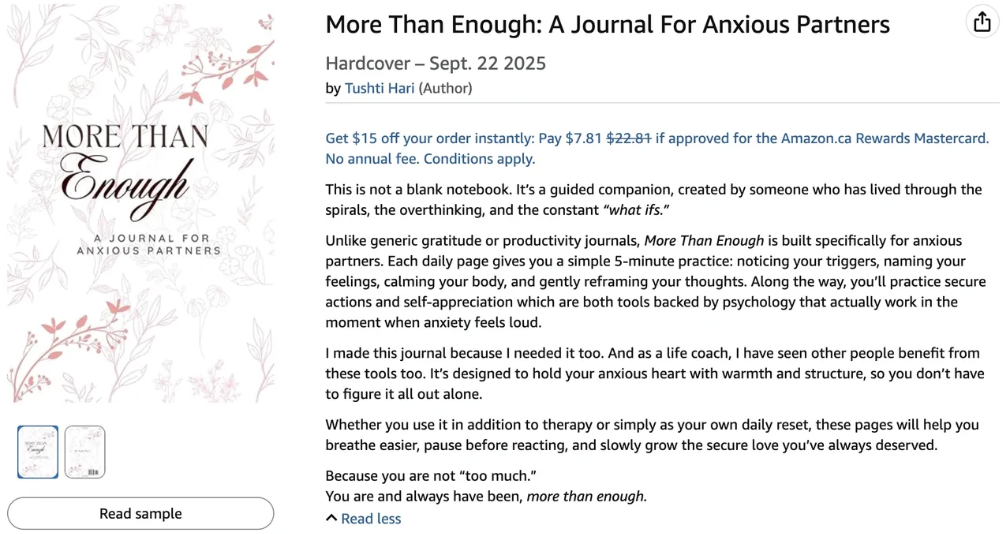
I didn’t set out to “be an author.” I set out to make something I needed on the days my thoughts felt loud and my heart raced for reasons I couldn’t name. Over time, through studying psychology, collecting evidence-based tools, and listening to stories from people just like me, that “something” became a guided journal called More Than Enough.
How the book began
My journey started with questions: Why do people spiral at night? Why is it so hard to be kind to ourselves when we’re stressed, in love, or in transition? In my own life, I kept reaching for simple practices that grounded me: a 60-second breathing reset, a compassionate reframe, a body map, or a small prompt that helped me name what I felt. I wrote these down, tested them, refined them, and shared them with others. The pages slowly turned into a structure of short, doable exercises that help you steady your body, organize your thoughts, and come back to a kinder voice inside.
Why mental health needs micro-steps
When we talk about mental health, it can feel overwhelming: therapy, diagnoses, long-term plans. All of that is important but sometimes, still out of reach. I believe in the power of micro-steps: practices you can do between classes, on your commute, before bed. The nervous system learns through repetition and safety; small daily signals of care add up. My journal was built for real life: you don’t need an hour, you just need a prompt and a soft landing. That being said, this micro-steps are not a replacement for therapy or diagnoses or long term plans but companions to help you in between sessions, or if you’re on a waitlist and want to try something small in the meantime.
Why More Than Enough
Each daily spread offers three things:
- Notice: a quick check-in to label what’s happening (body sensations, emotions, triggers).
Edit Image
- Soothe: a short regulation tool (breath pattern, grounding task, or movement cue).
Edit Image
- Reframe: a kind, evidence-based prompt to challenge unhelpful thoughts without shaming yourself.
Across the book, a few themes keep showing up. Self-compassion over self-criticism. You can still be accountable and gentle at the same time. Attachment and anxiety in relationships. Naming patterns helps us respond, not react. Boundaries as care. Limits protect energy, attention, and self-respect. Rituals for steadiness. Tiny routines make calm more repeatable.
Who it’s for
If you overthink after tough conversations, if your chest tightens when texts go unanswered, if you want to feel less at war with yourself, then this is for you. It’s especially supportive for students, young professionals, and anyone navigating big life changes or tender relationships. You don’t have to be “a journaler.” You just need a willingness to try one small thing today.
What I learned while writing
Writing this book taught me that healing isn’t linear and motivation isn’t magic. It’s built. On the days I doubted myself, I returned to the same tools the book teaches: labeling my feelings, breathing, and choosing one next step. I also learned that community matters. The conversations around Anxious Hearts Club (a little movement I’m building) reminded me that feeling deeply isn’t a flaw; it’s a signal for care.
An invitation
Whether you’re new to mental health or already on your journey, I hope this journal gives you structure without pressure, warmth without platitudes, and practices you can actually use. You are not “too much.” You are human and you are more than enough.
If this resonates with you, you can find my journal on Amazon, available globally. Shop now on Amazon (It is already on SALE). Check it out and I hope you love it as much as I do.
—
About the author: I’m a psychology grad and counselling student based in Toronto, creating accessible mental-health tools for everyday life. I share practical prompts and gentle education through my platform, Tee Talks, and the growing Anxious Hearts Club community. Read more about me here.
I write more about mental health here.