
Are you someone applying to universities for 2025 and feel that you do not have any idea as to what you want to study and where you’d want to study that. As someone who has almost finished my undergraduate degree in Psychology and Sociology, I got your back. Decision making can be a challenging task especially when it comes with societal expectations, external pressures and internal confusion. Lets use a step-by-step process to walk through your confusion and make this process easier for you!
STEP 1: Exploration and Self-reflection
Let’s start by creating our very regular mind map. In the centre of a blank page, you can write “what do I enjoy” and make several branches of activities, hobbies, even subjects that interest you. Try to include as much stuff as you’d like from volunteering to sports to music to chemical experiments, absolutely anything you enjoy. Now comes the important part: for each of these activities, I’d like you to write “why do you enjoy it” and this can be anything as I like it because I get my highest grades in it or I like it because I feel like I can I get to meet and interact with people. This activity is merely focused on self-reflecting about your interests and exploring what might you like and feel drawn towards.
STEP 2: Recognizing potential career paths
This is the time to visualize what might be some careers that incorporate your interests. One way to do so is by using a career test and there are multiple available online. For your convenience, you can use this Holland Test to find out some career paths for yourself. Shortlist around 3 career paths out of these and do some individual research. This can be about daily responsibilities of this role or educational requirements for this role. Take you time with this step. You can even use a similar mind map with the role/career path in the middle and everything about it around it like requirement of med school to be a doctor and then other things you find about it.
STEP 3: Narrowing Academic Interests
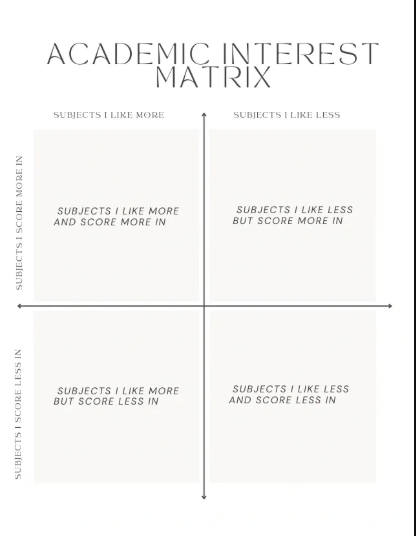
Once, you feel a little clear with career paths, it is time to focus more on the present. You can start by creating an academic interest matrix like the one shown here. Once done, the area with subjects you like and score well at are your prime focus areas and can help you better understand what might help you attain professional growth. While that is true, reflecting on subjects that you enjoy but score less on and subjects you score well on but do not really like might be important to understand your interests better.
STEP 4: Researching academic programs
Once you might know what you want to do, you may want to know where you can do this and how will that be like. Start by researching for each of your chosen programs/areas of interest at least 2 universities, either local or international. Try to choose universities with flexible and a variety of entry criteria before you shortlist. Also research about these individual programs including what subjects might be more focused upon, what experiences if anything unique does the program provide and how can this degree or program help you on your career path? Some unique features to look for is work-study options, study abroad programs, appealing mentorship programs. This step is essential to see what excites you and what can motivate you towards your application.
STEP 5: Evaluation based on Personal Preference
What you like and dislike plays a big role in your personal satisfaction. Take some time to see if you prefer to be somewhere close to home or away from it, if you like a big city or a small city vibe, comparing tuitions, campus institution or something that blends within a city and any other thing that might matter to you. Further your evaluation by researching about academic environment and social life. You can check up their instagrams, websites and learn if that is something you’d like to be a part of. You may even reach out to some alumni through your network or reach out on the University’s general e-mail.
STEP 6: Considering finances, awards and scholarships
You may want to consider your budget for university, your sources of income and compare between universities before you shortlist. After that, make an attempt at looking for scholarships and weighing universities based on if you are eligible for any of these scholarships based on merit or based on needs. Also consider additional costs especially costs of living, grocery/meal plan and anything else you may be spending money upon. This process can also help you understand if you require additional support for university education. This is also important because some programs may require additional resources than others and knowing these beforehand will help you plan and prepare better.
STEP 7: Decision Making and application process
I need you to end this by creating a table with your top 5-7 choices and rating each of your choice on a scale of 1-5 for each of the following: location, cost, personal fit, program content and additional support/facilities. This can help you finalize your choices based on both emotional and rational factors and make a reasonable decision. This shortlisted outcome can help you understand all individual requirements including application processes, document requirements and additional tests or letters required. Focus on each institution with care and follow along on their handles to understand the process before you apply. Once you hear back, you can then shortlist further and make a suitable choice.
This is merely a standard guide and can be used as a starting point, I would love to talk more about it with you based on your personal situation. Do not hesitate to reach out to me using my website or my instagram
I hope this seven step program can help you choose what you perceive as right for you and make a step forward in your educational journey!