
She talks about every little thing that does not even matter? He does not share anything about his feelings with me? My partner does not communicate with me after we have an argument? My partner pushes me to talk to resolve a fight?
Why do we feel the need to talk too much or too little? What is the right thing to do? We all communicate differently. Some of us need to talk things through immediately, while others require time to process before speaking. Some people express their emotions freely, and others keep them tightly guarded. But is communication itself really the problem in our relationships? Or is it something deeper—our ability (or inability) to comprehend those differences?Let’s dive right into it.
Communication and Attachment styles
Some people may naturally be more open, while the other prefers keeping things to themselves. Some people prefer words, while others rely on actions, body language, or even silence to express emotions. Some people may want to resolve conflicts immediately while others may require time to process it, need space and then come back to it. These differences are often misunderstood as a lack of communication when, in reality, they stem from how we’ve learned to relate to others.
Studies have found that our early experiences shape how we communicate in relationships. Attachment theory, originally proposed by John Bowlby and later expanded by Mary Ainsworth, explains how different attachment styles influence communication patterns (Bowlby, 1969; Ainsworth et al., 1978):
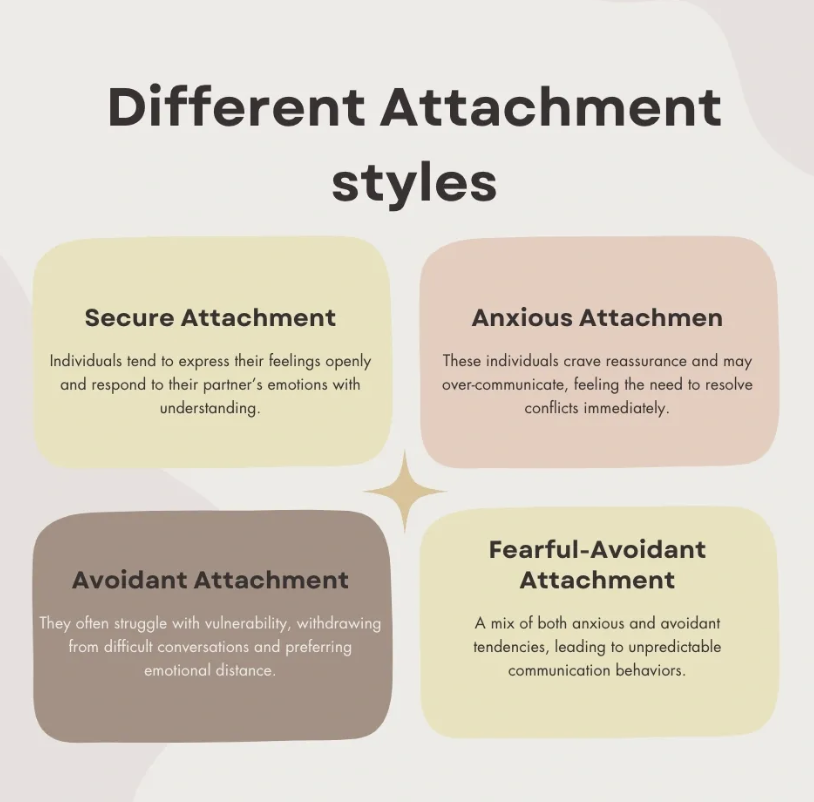
Research (Simpson & Rholes, 2017) suggests that attachment styles influence conflict resolution, emotional regulation, and relationship satisfaction. If one partner has an anxious attachment style and the other is avoidant, their communication patterns may clash, leading to misunderstandings rather than true communication failure. That, with an anxious attachment style, partner A would desire reassurance and constant communication but their partner B with avoidant attachment may completely avoid these conversations, affecting how each of them feel about their relationship especially during a conflict.
Communication vs. Comprehension: What’s the Real Issue?
Here’s the real problem: it’s not about talking too much or too little—it’s about understanding each other.
Many relationships suffer not because partners don’t communicate, but because they fail to comprehend the different ways they do. A study (Gottman & Levenson, 2019) highlights that successful relationships aren’t built on the sheer amount of communication, but on how well partners understand and adapt to each other’s communication styles.
So the next time you feel unheard or overwhelmed, ask yourself:
- Am I listening to understand, or just waiting to respond?
- Am I assuming my partner should communicate like me?
- Do I recognize their attachment style and how it affects their communication patterns?
By shifting our focus from simply ‘communicating’ to genuinely ‘comprehending,’ we foster deeper emotional connections. Understanding the root of communication struggles is far more powerful than just trying to ‘fix’ how much we talk or what we talk about. The next step? Learn to understand, not just speak.
References
Ainsworth, M. D. S., Blehar, M. C., Waters, E., & Wall, S. (1978). Patterns of attachment: A psychological study of the strange situation. Lawrence Erlbaum.
Bowlby, J. (1969). Attachment and loss: Vol. 1. Attachment. Basic Books.
Gottman, J. M., & Levenson, R. W. (2019). The mathematics of marriage: Dynamic nonlinear models. MIT Press.
Simpson, J. A., & Rholes, W. S. (2017). Adult attachment, stress, and romantic relationships. Current Opinion in Psychology, 13, 19-24.