
You planned a whole romantic dinner with fairy lights, candles, and their favorite food but they didn’t look that impressed.
Meanwhile, they fixed your broken laptop last week, and you barely noticed.
Both of you are thinking the same thing:
“Why do I even try? They clearly don’t care.”
Here’s the plot twist: you both care, but you’re speaking completely different love languages. No wonder it feels like you’re talking into the void.
What Are Love Languages?
Dr. Gary Chapman’s Five Love Languages theory isn’t just cute Instagram quiz content. It’s a proven framework to understand how people express and receive love.
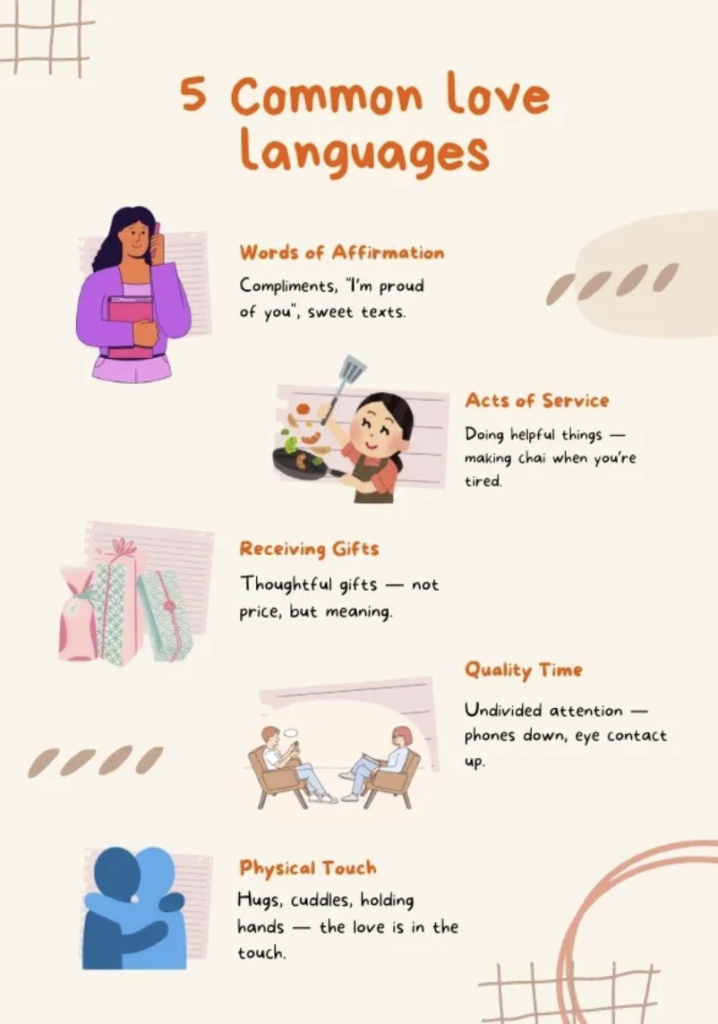
Let’s say you’re all about Words of Affirmation and you want “I miss you” texts and romantic captions. But your partner’s love language is Acts of Service and they think fixing your WiFi or dropping you to class is peak romance.
Neither of you is wrong. You’re just broadcasting love on two completely different channels. This is the love language mismatch struggle.
Psychologists believe love languages are shaped by:
- Childhood Experiences. How did your parents show love? Words? Hugs? Gifts?
- Cultural Influences. In some cultures, providing is love; in others, it’s all about open affection.
- Past Relationships. What worked (or hurt) in past relationships often defines what you crave now.
Love languages aren’t just romantic. They apply to literally every relationship.
- Your bestie might feel closest to you when you spend time binging shows together (Quality Time).
- Your mom might feel most loved when you do the dishes without being asked (Acts of Service).
- Your sibling might want random cute gifts (Receiving Gifts) because that’s how they connect.
How To Find Out Your Love Language (And Your Partner’s)
1. Ask Yourself: When do I feel most loved: after a compliment? A hug? A thoughtful surprise? What do I naturally do when I love someone: do I write them notes, buy them things, help them with stuff?
2. Take The Quiz Together
Chapman’s official quiz is super fun to do with your partner, friends, or even your parents. Because yes , your mom also has a love language. And we can have different styles with different people or at different times.
3. Observe Their Natural Style
If they always fix things for you, they’re probably Acts of Service. If they can’t stop touching your hair, they’re a Physical Touch person. If they send morning texts and cute notes, they’re Words of Affirmation.
What To Do When You and Your Partner Have Different Love Languages
No surprises here, a lot of us are bound to have different love languages, we may even have different things we like at different times of our lives and we may even like acts of service and physical touch to the same extent. However, we can use some techniques to understand these differences between ourself and our partners to avoid conflicts and enhance appreciation.
1. Learn Each Other’s Language (Even If It Feels Awkward)
If you’re not a words person but your partner is, sending a random “You mean a lot to me” text might feel unnatural, but to them, it’ll feel like fireworks.
2. Stop Expecting Your Language Back
Just because you show love with gifts doesn’t mean they will. It’s about receiving love in their way and not expecting a perfect mirror. However, talk about what you’d like and let them know.
3. Mix It Up
Even if you have a primary language, everyone can like a little mix of all five.
- Text them sweet things (Words).
- Surprise them with their favorite snack (Gifts).
- Plan a no-phone coffee date (Quality Time).
- Fix their laptop (Acts of Service).
- Hold their hand while walking (Physical Touch).
Love is multilingual.
Most couples (and friends, and families) don’t have the same love language. That’s normal! The key isn’t to change who you are. It is like being bilingual. Learn to speak their language while teaching them yours to improve romantic relationships.
It’s literally just good communication with a romantic twist. Loving someone isn’t just about feeling love, it’s about learning how to show love in a way they can actually recognize. Love is a lot like WiFi meaning if you’re not on the same frequency, the connection’s gonna suck
One honest caveat about love languages
Before you go and categorise everyone you know, it is worth saying what this framework is and what it is not.
Gary Chapman was a pastor and counsellor, and the five love languages came out of what he noticed in his counselling room rather than out of a research programme. Researchers have since gone looking. Egbert and Polk tested whether the five categories hold up as distinct measurable things and found the picture messier than the book suggests. People do not sit neatly in one category, the categories overlap, and most of us want more than one of these depending on the week and the year.
Which does not make it useless. It makes it a vocabulary rather than a diagnosis. Having words for I feel loved when you do things for me is genuinely helpful, right up until it becomes I am a words person, so you should have known. The moment it turns into an identity, it stops being a tool and starts being an excuse.
A better question than what is your love language
Here is the one I find more useful, particularly for people who grew up in Indian households.
What did care look like in the house you grew up in?
Because for a lot of us it did not look like words at all. It looked like fruit cut and left on a plate without a word. Someone waiting up. A father who never once said he was proud and who drove four hours to collect you. If that is the house you came from, the fairy-lights dinner may genuinely not register as love, and it is not because you are cold. It is because nobody ever showed you love in that dialect.
Asking your partner that question tells you more in ten minutes than a quiz will, because it comes with the evidence attached. And it goes both ways, which the quiz does not.
If you want somewhere to begin, I have written five questions for partners, and one of them is a version of exactly this: teetalks.org/questions
Sources
- Chapman, G. (1992). The Five Love Languages: How to Express Heartfelt Commitment to Your Mate. Northfield Publishing.
- Egbert, N., & Polk, D. (2006). Speaking the Language of Relational Maintenance: A Validity Test of Chapman’s Five Love Languages. Communication Research Reports, 23(1), 19-26.
- Givertz, M., Segrin, C., & Hanzal, A. (2009). The Association Between Satisfaction and Commitment Differs Across Marital Status and Gender. Journal of Social and Personal Relationships, 26(5), 585-604.
- Official Love Languages Quiz: https://www.5lovelanguages.com/quizzes/
What you have just read is psychoeducation: general information and reflection, written for a lot of people at once. It is not therapy, an assessment, or a diagnosis, and it is not advice about your particular situation. Reading it does not make us a practitioner and a client.
If you are carrying something heavy, please talk to a qualified mental health professional who can actually see you and your circumstances. And if you are in crisis or thinking about harming yourself, please do not start here. In India, Tele-MANAS is free and open 24 hours on 14416, in English and 20 other languages. Anywhere else, findahelpline.com has the number for your country.