
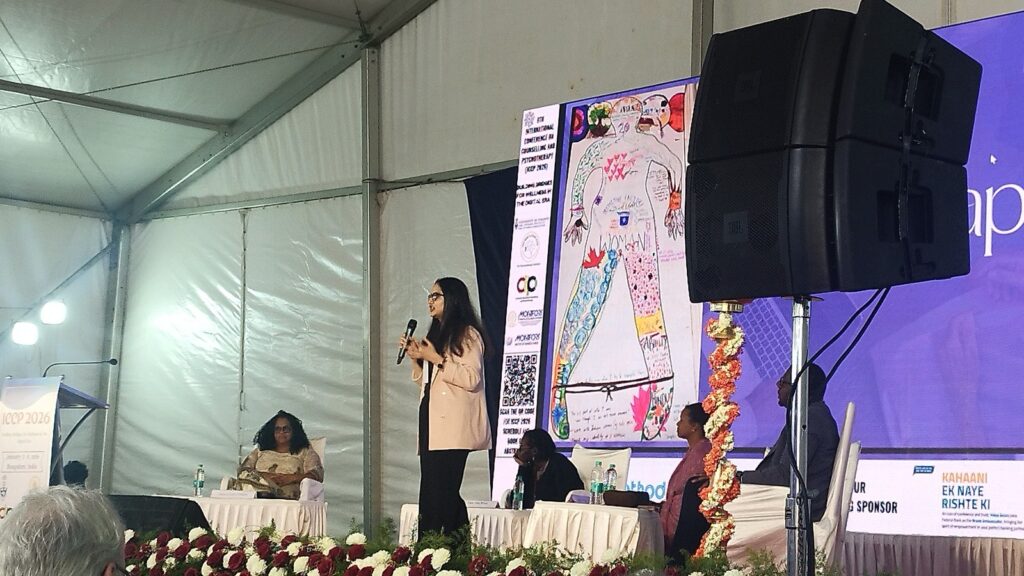
You start with a blank silhouette. Sometimes it is traced around your own body on a sheet of paper big enough to lie down on. Sometimes, when the room is small or the group is large, it is a printed outline on A3.
Then you put things on it. Colour, texture, symbols, words, drawings, placement. Where does this live in you. What shape is it. What colour. What is next to it.
That is body mapping, described as plainly as I can describe it. It sounds almost too simple to be a method. It is not, and I want to explain why, because I have spent the last two years working with it, and it has changed how I understand my own training and how I sit with the people I work with.
Where the method actually comes from
Body mapping is not new and it is not mine. It has a lineage, and I think the lineage matters, because it tells you what the method was built to do.
It was first introduced in 1987 by Cheryl MacCormack and Alizon Draper, as a qualitative research method exploring the social and cognitive dimensions of female sexuality in Jamaica. Participants traced their bodies and visually represented their experiences of womanhood. What came out of it was not what a questionnaire would have produced. Participants articulated embodied understandings of identity, sexuality, power, and social expectation, in a form that verbal survey questions had not been able to reach.
The method was then adapted in South Africa in the early 2000s, most visibly in the work of the Bambanani Women’s Group in Cape Town, working with women living with HIV who were receiving antiretroviral treatment from Medecins Sans Frontieres. The sessions were led by the South African artist Jane Solomon, and the maps were published in a collaborative book called Long Life: Positive HIV Stories. That work is probably the reason most people who know body mapping know body mapping. It demonstrated the method’s capacity to hold trauma, resilience, stigma and survival at the same time, on the same sheet of paper, without forcing any of them into a sentence first.
Since then it has been used in refugee research, in trauma therapy, and in somatic pedagogies. Across very different contexts, the finding that keeps repeating is the same: people report heightened self-awareness and insight through this embodied mode of inquiry, and they often surface things they had not previously been able to say.
So it began as a research method, and it became a teaching method, and it is now being explored as a communication aid in clinical and community settings. I sit in that third space.
How I came to it, and why the timing was not an accident
I learned body mapping in a classroom, in the first year of my Master’s in Counselling Psychology and Global Mental Health at the Ontario Institute for Studies in Education, University of Toronto.
The reason it was introduced is worth telling, because it is a story about this exact moment in education.
Multicultural counselling training has always relied heavily on the reflective essay. You read about race, gender, class, sexual orientation, disability, age and religion, and then you write about how they operate, including how they operate in you. The essay was the instrument for checking whether a student had actually done that interior work.
Then AI arrived, and the essay stopped being a reliable instrument.
This is not a complaint about students. It is an observation about assessment. A student can now produce a piece of writing about privilege and positionality that is analytically sophisticated, properly referenced, and correct, without ever having sat with the uncomfortable question of where their own privilege lives in their own life. The text looks the same. The learning is not there. And in this particular field, the learning is the entire point, because you cannot practise culturally responsive therapy from a position you have only ever read about.
So the faculty reached for something an AI cannot do for you. You cannot outsource lying on the floor while somebody traces around you. You cannot outsource deciding whether your class belongs in your stomach or your hands.
That is the context in which I made my first map.
The map I made, and the one I keep making
The assignment structured itself around what my programme calls the Big Seven: gender, race, class, sexual orientation, disability, age and religion. We were asked to map those identities onto a body outline, take the map home, keep reading, and keep revising it.
I am not going to walk through my map identity by identity here, partly because the detailed version belongs in the paper and partly because a map explained line by line stops being a map and becomes a caption. But I can tell you what making it was like, which is the part people actually want to know.
It starts blank, and the blank is uncomfortable. I did not know how to separate my identities from each other, let alone decide where each one lived. Nothing arrives pre-sorted.
Then you make a first pass, and it is rough and slightly embarrassing, and you take it home. You read. You come back to it. Something you placed confidently last week looks wrong. Something you left out asks to be put in. By the third or fourth pass you are not illustrating the reading any more. You are noticing things and then going to look for the reading that explains them, which is the opposite direction and a much better one.
The detail of mine that people always ask about is that my map has more than one head. One was not enough. The pressures that organise my thinking do not arrive from a single place or speak in a single voice, and when I tried to draw them as one, the drawing was simply untrue. So there are several, and each one is a different source.
I have kept revising it long after the assignment was submitted. It has become less like an assignment and more like a time-lapse of a few years of my life.
What the map did that an essay would not have
Two things came out of that process that I do not believe writing would have produced.
Placement forces a decision that language lets you avoid. In an essay you can write that identity is complex and intersecting, which is true and costs you nothing. On a body you have to put the thing somewhere. Choosing where is an act of interpretation, and you learn as much from the hesitation as from the final position.
Visibility makes a belief contestable. Once something is drawn, it is outside you, on paper, where it can be argued with. A narrative you have carried silently for twenty years has never had to defend itself. A narrative drawn on a wall has.
Presenting it to the group added a third thing. Hearing how other people placed the same seven identities, in completely different parts of the body, for completely different reasons, does something to your assumptions that no amount of reading about diversity manages.
Bringing it to India
Earlier this year I presented this work at the International Conference on Counselling Psychology in Bangalore, alongside my supervisor, and I presented my own map as part of it. That research is currently in the publishing process.
We also co-facilitated a workshop at the conference, on body mapping for stress. That was the first time I watched the method work in a room of people who had not chosen a Master’s programme about it. It held.
That work is part of what led me here. I am now in Bengaluru as a supervised practicum trainee, and I use body mapping with clients in some form most weeks. Sometimes that is a full map. Much more often it is a fragment: a single outline, one question, one part of the body. The method scales down without losing much.
I have also started running body mapping workshops in schools and colleges here, because the awareness is not yet there and I think it should be.
Why this method and this country
I want to make an argument here rather than a claim.
India has profound linguistic diversity and high mental health stigma, and those two things compound each other in a specific way. A person may not have the emotional vocabulary in the language of the clinic. A person may have it and still not be willing to use it, because saying it out loud in that language, in that room, carries a cost at home.
There is also a long line of cross-cultural psychiatry research showing that in many cultures, including much of South Asia, distress is more likely to be presented and experienced in the body than described in emotional terms. The heavy chest. The tight shoulder. The stomach that has been off for weeks. I have written elsewhere about what that means when the scan comes back clear.
Body mapping does not require you to have the word first. It lets you point. It lets you colour something in. It lets the body do the reporting it is already doing, in a format somebody else can see.
That is why I think it is worth building awareness of here specifically, rather than importing it as a general good.
What body mapping is not
This matters more than anything else in this piece, and I want to be precise.
It is worth saying where the evidence actually stands first. A scoping review in The Lancet Psychiatry mapped how body mapping has been used across mental health research. A more recent scoping review in The Arts in Psychotherapy, by Buys, Peel and Buiten in 2025, looked specifically at body mapping as a therapeutic activity and found real promise alongside real limits: the existing studies are mostly small and exploratory, and the authors were explicit that the method needs trained, trauma-informed facilitators and clearer guidelines before anyone treats it as established practice.
I agree with them, and the rest of this section is what that caution looks like in practice.
It is not art therapy. They are related and they are not the same. Body mapping does not require artistic skill and does not aim at artistic outcome. Stick figures and scribbles are fine.
It is not diagnostic. Nothing on a map tells you what someone has. A symbol in a location is not a sign of anything.
The facilitator does not interpret. This is the rule I hold most tightly. I do not tell anybody what their cactus means, or why it is significant that they put something in their chest. The meaning belongs to the person who drew it. My job is to ask, and then to be quiet.
It is not a replacement for anything. In the framework I am presenting, body mapping sits alongside direct enquiry, structured risk assessment, safety planning and referral. It is an adjunct. It may help start a conversation. It does not substitute for the conversation.
And nothing on it is compulsory. Participants control what they represent and what they disclose. Opt-out choices are built in, not offered grudgingly.
The safety architecture
When body mapping goes near difficult material, and it does, the guardrails are not optional extras. In the framework I work with, they include grounding before and after, the option to opt out of any layer, private follow-up rather than public disclosure, supervision for the facilitator, and an established escalation pathway agreed in advance.
Any indication of current risk prompts direct assessment and locally appropriate emergency or safeguarding procedures. Immediately. That is not a footnote.
I say this because an evocative method in untrained hands is a hazard, and the enthusiasm around arts-based work sometimes outruns the caution.
What I am presenting next
At the end of this year I am presenting a PechaKucha at NSPRITE at NIMHANS, titled When Words Fall Short: Body Mapping for Culturally Responsive Suicide Prevention Conversations.
It proposes a trauma-aware body-mapping framework for trained counsellors, organised into four layers: embodied distress; personal, relational and cultural pressures; protective connections and reasons for living; and one immediate support or safety step. Twenty slides, starting from a blank silhouette.
I want to be honest about the status of this work. These are testable propositions, not established intervention effects. Feasibility, acceptability and safety all require co-designed evaluation with people who have lived experience. I am proposing a framework and arguing it is worth investigating. I am not claiming it works.
I would rather say that clearly than oversell something I care about.
Why I keep going back to it
I am early in this. I am a counsellor in training, working under supervision, and I have been with this method for two years, not twenty.
But two years is long enough to notice one thing repeatedly: the map gets somewhere the conversation was not getting. Not always, not with everyone, and not as a substitute for the conversation. But often enough that I keep reaching for it.
My own map is still not finished. I am fairly sure it is not supposed to be.
Further reading
- Body mapping for arts-based inquiry in mental health research: a scoping reviewThe Lancet Psychiatry, 2023
- Body mapping as a therapeutic activity in psychotherapy practice: a scoping reviewBuys, Peel & Buiten. The Arts in Psychotherapy, 2025
- Body Maps: Art and MemoryThe Bambanani Women’s Group, Cape Town, 2003. Medecins Sans Frontieres
- Long Life: Positive HIV StoriesThe book the original body maps were published in
The next body mapping workshop is free and online. The date is not fixed yet. Join the waitlist and you will be emailed as soon as it is.
What you have just read is psychoeducation: general information and reflection, written for a lot of people at once. It is not therapy, an assessment, or a diagnosis, and it is not advice about your particular situation. Reading it does not make us a practitioner and a client.
If you are carrying something heavy, please talk to a qualified mental health professional who can actually see you and your circumstances. And if you are in crisis or thinking about harming yourself, please do not start here. In India, Tele-MANAS is free and open 24 hours on 14416, in English and 20 other languages. Anywhere else, findahelpline.com has the number for your country.