
Every time I run a body mapping session, somebody asks a version of the same question. What does it mean if I put red on my chest? What does the throat stand for? Is there a chart?
There is not. And the absence of that chart is the most important thing about this method, so this post is about the limits rather than the promise.
It does not diagnose anything
A body map is not an assessment. It produces no score, no category and no label. Nothing about it tells you whether what you are living through is anxiety, burnout, grief or an ordinary difficult month.
That is not a weakness in the tool. It is the design. The moment a reflective exercise starts producing labels, two things happen. People begin treating the page as a verdict, and the facilitator starts behaving like a clinician who has assessed them. Neither is true, and both are risky in a room where nobody has been assessed at all.
It does not assign fixed meanings to body parts
There is no dictionary in which the shoulders mean responsibility and the throat means unspoken words.
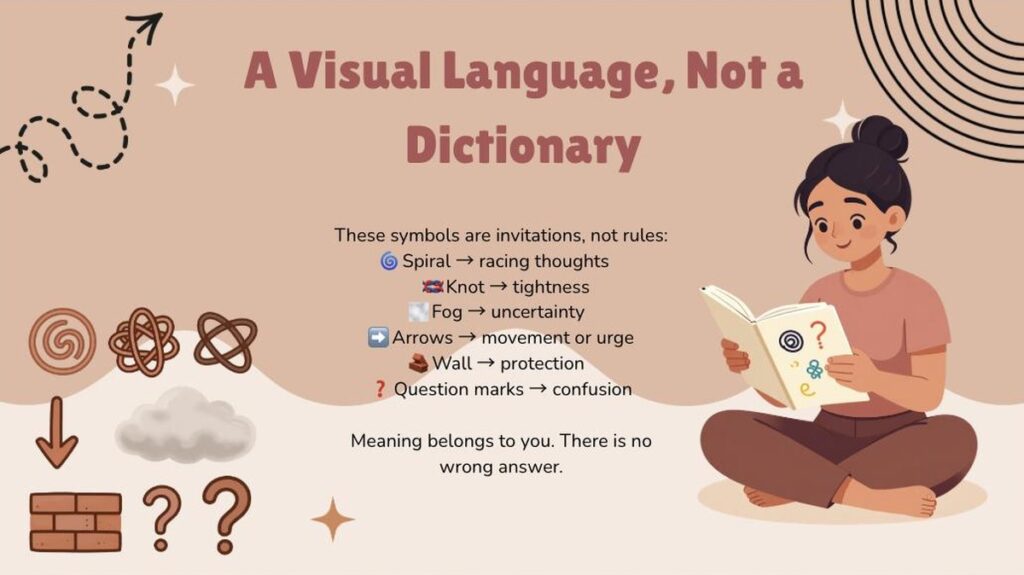
In sessions I do offer examples, because a blank page is hard to start. A spiral often stands in for racing thoughts. A knot for tightness. Fog for uncertainty. A wall for protection. But the slide those examples sit on says the important part out loud: these symbols are invitations, not rules. Meaning belongs to the person who made the mark, and there is no wrong answer.
So when we read a finished map together, nobody is told what their symbols mean. Not by me, not by anyone else in the room. We describe what we see, and we ask the person what it was like to make it. We reflect, and we do not interpret.
It does not prove that an emotion lives in one place
Research does support the broad idea that emotional states come with physical patterns. In a well known study published in PNAS in 2014, researchers asked around seven hundred people in Finland, Sweden and Taiwan to colour in where they felt different emotions in the body, and found the patterns were surprisingly consistent across those groups. You can read Bodily maps of emotions for yourself.
What none of that establishes is the stronger claim, the one that circulates on social media: that a specific emotion is stored in a specific body part, or that a physical symptom can be read backwards to reveal a buried memory. That is not what the evidence shows, and a body map is not evidence of it either.
The honest description is this. Body mapping is a reflective and expressive practice, used in health research and community settings for more than two decades, with a real qualitative literature behind it and a thin quantitative one. It helps people put private experience into a form they can look at and talk about. It is not a treatment, and it has not been shown to be one.
It does not need any artistic ability
This is the fear that actually stops people, and it is the easiest one to remove.
Nobody is looking at the drawing. A map made of stick lines, three colours and a lot of handwriting does exactly the same job as a beautiful one. In sessions, the most useful maps are often the messiest, because the person was busy noticing rather than composing.
If the drawing is coming out badly, the exercise is going well.
It does not replace support
A body map can show you the chain. What the body noticed, what feeling came with it, what you wanted to do, and the sentence your mind supplied. Seeing that laid out is genuinely useful, and for some people it is the first time any of it has been separated out.
It is still a page. It does not process what it surfaces. If your map keeps bringing up the same heavy thing, that is information worth taking to a qualified professional rather than to a bigger sheet of paper.
And any physical symptom belongs to a doctor first. Always. A tight chest gets medically checked before it gets creatively explored.
So what is it for
For noticing, in a form you can see. For the specific relief of being able to point at something instead of carrying it silently. And in a group, for the discovery that the thing you thought was only yours is drawn on the same page four times, in four different handwritings.
That is a smaller claim than the internet usually makes about this work. It is also a true one, and so far it has been enough.
The next body mapping workshop is free and online. The date is not fixed yet. Join the waitlist and you will be emailed as soon as it is.
What you have just read is psychoeducation: general information and reflection, written for a lot of people at once. It is not therapy, an assessment, or a diagnosis, and it is not advice about your particular situation. Reading it does not make us a practitioner and a client.
If you are carrying something heavy, please talk to a qualified mental health professional who can actually see you and your circumstances. And if you are in crisis or thinking about harming yourself, please do not start here. In India, Tele-MANAS is free and open 24 hours on 14416, in English and 20 other languages. Anywhere else, findahelpline.com has the number for your country.