
Arguments are an inevitable part of any relationship. Whether it’s a romantic partnership, a friendship, or even a familial relationship, disagreements happen because we are individuals with unique experiences, thoughts, and emotions. But why do we fight, and how can we handle conflicts better? Let’s explore the psychology behind arguments and learn strategies for healthier communication.
Why Do We Argue?
- Unmet Needs: Often, conflicts arise when one or both partners feel unheard, unappreciated, or neglected. According to Maslow’s Hierarchy of Needs (Maslow, 1943), emotional connection and security are fundamental. When these are threatened, we react defensively.
- Different Communication Styles: The way we express ourselves varies. Some people are direct, while others are more passive. Miscommunication fuels tension. Deborah Tannen’s (1990) research on gendered communication styles highlights how men and women often approach conflicts differently, leading to misunderstandings.
- Emotional Triggers: Past experiences shape our reactions. If someone has been hurt before, they may react strongly to situations that resemble past pain. This is tied to attachment theory, which explains how our early relationships influence our adult interactions (Bowlby, 1969).
- Power Struggles: Sometimes, arguments aren’t about the issue at hand but about control and independence. Psychologists like John Gottman have studied relationship dynamics and found that a need for dominance or equality often underlies fights (Gottman, 1999).
- Stress & External Factors: Work pressure, financial stress, or even a bad day can lead to heightened emotions, making small issues seem larger than they are.
The Four Horsemen: Gottman’s Theory on Relationship Conflicts
John Gottman, a renowned relationship psychologist, identified four toxic behaviours that predict relationship failure:
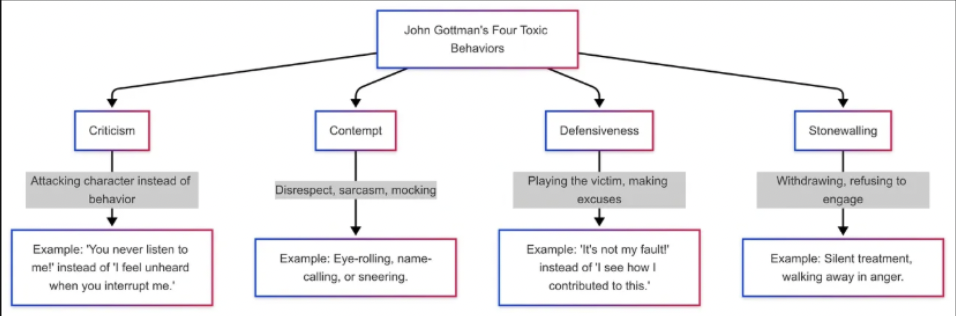
The key to healthy relationships is to replace these with:
- Gentle communication [Instead of saying: “You never consider what I want! It’s always about your family.” Try acknowledging their feelings too. “I know how much seeing your family means to you, and I also value our time together. Maybe we can find a way to balance both? What if we visit them for a while and then have an evening just for us?”]
- Respect and appreciation [This is about noticing efforts your partner might be putting in your family, their work and appreciating it with words and actions like “I see how hard you’ve been working lately, and I really admire your dedication. I appreciate everything you do for us. How about I make dinner tonight so you can rest?”]
- Taking responsibility [This is especially important when you make a mistake. Instead of just being defensive and shedding the blame: “You should have reminded me!” try to own up to your mistake. “I completely forgot, and I see that it messed up our dinner plans. That was my mistake, and I’ll make sure to set a reminder next time. Can I order takeout to make it up to you?”.]
- Active listening [When our partner shares something with us, it is less about how we feel about those situations and more about validating their feelings and helping them feel heard in that situation. Instead of saying: “Just let it go, it’s not a big deal.” we can try acknowledging, “That sounds really frustrating. It makes sense why you feel that way. Do you want advice, or would you rather just vent?”
How to fight right?
Conflicts and inevitable and honestly, a life without any disagreements would not feel as good. Some disagreements help us learn and grow and be better for ourselves and our partners. Here are some way you and your partner can practice healthier communication even during conflicts.
- Pause Before Reacting: Take a moment before responding. Ask yourself, “Is my reaction based on the present issue or past experiences?”
- Use “I” Statements: Instead of saying, “You never listen to me,” try “I feel unheard when we talk about important things.” This shifts the focus from blame to understanding.
- Practice Active Listening: Instead of formulating a response while the other person is talking, really hear them out. Repeat back what they said to show understanding.
- Pick the Right Time & Place: Don’t start difficult conversations when either of you is already stressed. Create a calm environment to talk.
- Find a Resolution, Not a Winner: Relationships are not competitions. The goal is not to win but to understand and grow together.
- Know When to Take a Break: If emotions are running too high, step away and revisit the conversation later. Gottman suggests that at least 20 minutes of cool-down time can help reset emotional reactions.
Fights are natural, but they don’t have to be destructive. Understanding the psychology behind arguments helps us navigate them with empathy and care. The next time you find yourself in a disagreement, remember: it’s not about who’s right or wrong, but how you work through it together.
References
- Gottman, J. (1999). The Seven Principles for Making Marriage Work.
- Maslow, A. H. (1943). A Theory of Human Motivation. Psychological Review.
- Tannen, D. (1990). You Just Don’t Understand: Women and Men in Conversation.
- Bowlby, J. (1969). Attachment and Loss.