
Two students come to me in Grade 12. The first has one activity outside class and a growing sense of panic. The second has twenty, in every direction at once, and no idea what any of it says about them.
Both have the same problem, and it is not the activities. It is that the thinking started in Grade 12.
Grades get you considered, not chosen
Here is the uncomfortable arithmetic. Nearly every student applying to a competitive university has the grades. That is what makes it competitive. So grades move you from the large pile to the smaller pile, and then they stop working, because everybody left in the smaller pile has them too.
What separates people after that is evidence. Not who you are, but what you have actually done that shows it.
You might be the kindest person in the room. You may be the most hardworking, the most curious, the most determined. None of that travels on paper unless it left a trace somewhere outside your own head.
The right time to start is when an interest shows up
Not Grade 11. Not the summer before applications. The moment something genuinely catches you.
For most students that is somewhere in the middle of Grade 9 or during Grade 10. Late enough that school has stopped being entirely new, early enough that two or three years of following something is still possible. Two years of one interest is worth more than twenty activities collected in six months, because two years shows a person, and six months shows a scramble.
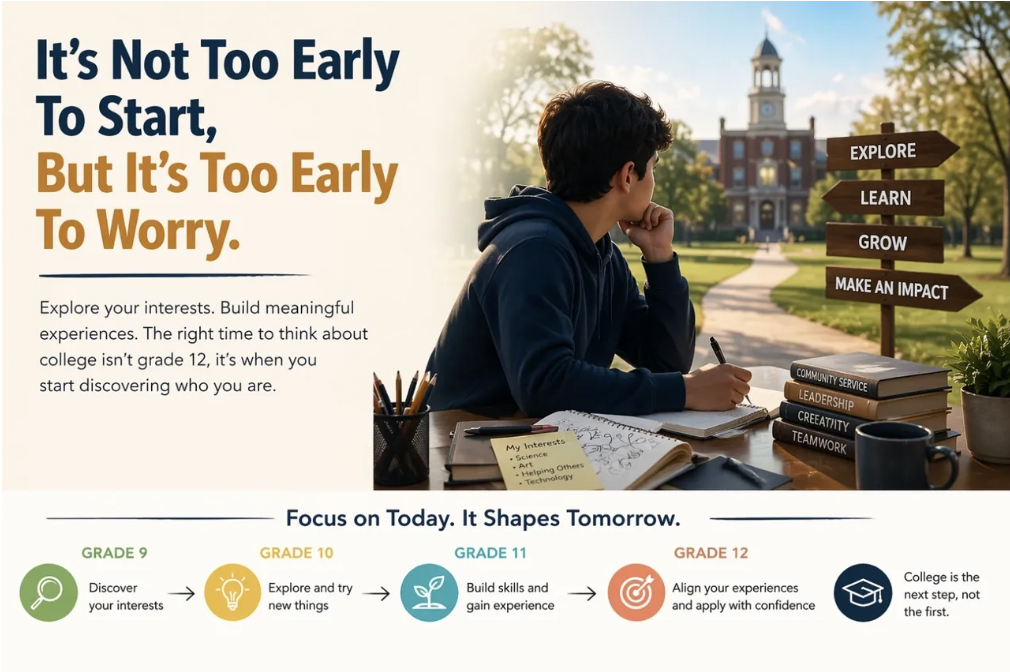
What the four years can look like
This is a shape, not a prescription. Plenty of people start later and are fine.
Grade 9: try things and pay attention to yourself
Do not optimise anything yet. Join what sounds interesting, quit what does not, and notice which things you keep thinking about on the way home. That noticing is the actual work of this year. Nobody is going to ask you for a Grade 9 record.
Grade 10: pick two and go deeper
By now there are usually one or two things that keep coming back. Go further into those and let the rest go. Depth starts here, and depth is the thing that is impossible to fake later.
Also worth doing: find out what people who do this thing seriously actually do all day. A surprising number of students discover in Grade 10 that they liked the idea of something and not the thing itself, which is a very cheap lesson at that age.
Grade 11: make something that exists outside you
This is the year that carries the most weight and the one most people waste. Whatever you have been doing, turn some of it into something with an outside edge. Run the event. Teach the younger group. Write the thing and publish it. Enter the competition and lose it.
It does not have to succeed. It has to have happened, because an application can describe a thing that happened and cannot describe an intention.
Grade 12: assemble, do not begin
If the earlier years went reasonably, this year is writing, not building. The essays have material to draw on. The recommendation letters come from people who have watched you do something for two years rather than teachers who know your marks.
If you are in Grade 12 right now and none of the above happened, you have not missed your life. You have one useful move, described below.
If you are already in Grade 12
Do not try to manufacture a portfolio in four months. Admissions readers see hundreds of those and they read exactly as what they are.
Instead, take the one thing you have done that was real, however small, and go deep on it fast. One genuine project, properly finished, with something you can point to, beats eight new memberships. And write honestly about the direction you are moving in rather than pretending you have been moving in it for years.
A word to parents
The most common version of this conversation in Indian families is a list. Add debate, add coding, add the olympiad, add volunteering. The list is assembled for the application rather than for the child, and it is visible from a long way off.
The more useful question is the quieter one: what does your child return to when nobody is assigning it? Build outward from that. It is also, not incidentally, the version that does not exhaust them by seventeen.
What this is really about
The point of starting early is not a stronger application, although that tends to follow. It is that a student who has spent three years following something has a much clearer idea of who they are when they arrive at university, and that turns out to matter more than where they arrive.
The ones who struggle most in first year are rarely the ones with weaker grades. They are the ones who did everything right and never asked themselves why.
If this is a conversation you want to have at home rather than a lecture you want to deliver, I have written question sets for exactly that: teetalks.org/questions
What you have just read is psychoeducation: general information and reflection, written for a lot of people at once. It is not therapy, an assessment, or a diagnosis, and it is not advice about your particular situation. Reading it does not make us a practitioner and a client.
If you are carrying something heavy, please talk to a qualified mental health professional who can actually see you and your circumstances. And if you are in crisis or thinking about harming yourself, please do not start here. In India, Tele-MANAS is free and open 24 hours on 14416, in English and 20 other languages. Anywhere else, findahelpline.com has the number for your country.