
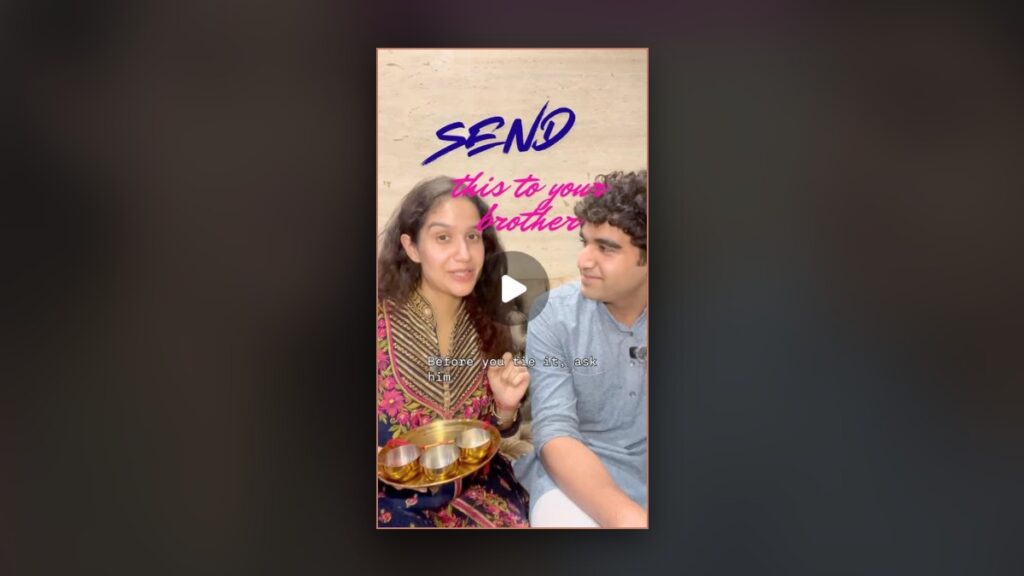
The thread goes on in about ten seconds. The sweet takes another five. Then there is an envelope, a photo for the family group, and everybody moves on to lunch.
That is the whole ritual, most years. We have been doing it since before either of us could remember doing it, and somewhere along the way it turned into an errand with good lighting.
This year I tried something different. I sat my brother down before the thread went on and asked him four questions.
Why a festival is the easiest place to do this
There is a reason I did it on Rakhi and not on a random Tuesday.
Most of the year, asking your brother a direct question about your relationship requires you to manufacture a reason. You have to invent an occasion, which means you have to admit you wanted one, which is the part that feels exposing. On Rakhi the occasion already exists. Nobody has to explain why the two of you are sitting together talking about being siblings. The festival has done the awkward work for you.
That is what rituals are for, psychologically. They give people permission to feel something out loud on a fixed date so that nobody has to be the one who brought it up. We already use Rakhi for the sentiment. We just deliver the sentiment in a form that carries almost no information: a thread, a photo, a transfer.
So the question I had was simple. What if we used the slot the festival already gives us for something that actually tells us something.
The four questions
One. When we were kids, have I done something you haven’t forgiven me for yet?
This one sounds heavy and is usually not. Most of what comes up is small and specific and nothing like what you expected. The value is not in the apology. It is in finding out that a thing you have completely forgotten has been sitting in someone else’s head with a label on it.
Two. When do you think you stopped telling me things?
My brother said around tenth grade.
I did not know that. I had that whole period filed away as normal and uneventful. Hearing a year put on it rearranged a few things. Not dramatically. I did not discover a secret. I just learned that a door closed on a date, and I had not noticed the date.
Three. How do you think I’ve influenced you in your life?
He said my being around had made him more emotionally mature. He would not say that again if you asked him tomorrow. He would probably deny saying it at all.
Siblings almost never tell each other this. We will say it about our parents, about teachers, about friends. About a sibling it feels like flattery, or like admitting a debt. So it goes unsaid for thirty years by two people who are both, quietly, curious about the answer.
Four. What do you need from me now that we’re both adults?
I saved this one for last on purpose, and I want to explain why, because the order is doing real work.
The first three questions are about what already happened. They are safe in the way history is safe. You cannot be held to them. Question four is the only one that asks for something going forward, and it lands completely differently once the other three have softened the ground.
If you open with question four, it sounds like a complaint dressed as a question. If you arrive at it after the other three, it sounds like the natural next thing to say.
What actually happens when you ask
He paused a lot. He said “I don’t think” and then went quiet for a while. He laughed at the wrong moments. Two of his four answers were under ten words.
I am telling you this because I know what people picture when they see a reel like this. They picture two siblings giving each other beautifully composed paragraphs, and they correctly conclude that their own brother would never. Mine did not either.
Real answers are short and badly timed and slightly embarrassed. That is what a true answer sounds like when somebody is speaking a language they have not used before. Do not measure the conversation by how articulate it was. Measure it by whether you learned one thing you did not know.
The relationship nobody plans for
Here is something worth sitting with. Your sibling relationship is, for most people, the longest relationship of their life. It starts before your first friendship and outlasts your parents. It will probably outlast most of the people you work with, and for many people it outlasts a marriage.
And it is the one relationship almost nobody puts any deliberate effort into. We plan for marriages. We work on friendships. We read about our parents. The sibling relationship we simply assume, because it was there from the beginning and it did not require anything from us to exist.
But existing and being alive are not the same thing. A lot of adult sibling relationships are technically intact and functionally silent. Two people who know each other’s history in enormous detail and know almost nothing about each other’s present.
The research on long lives keeps circling the same point. The Harvard Study of Adult Development, which has followed the same group of people for more than eighty years, has found again and again that the quality of a person’s close relationships is one of the better predictors of their health and happiness in later life. It does not say which relationships. It does say that having live ones matters more than having many.
A sibling is the cheapest live one available to you. The history is already built. You are not starting from zero. You are restarting something.
If you are going to try it
Do it during something. The tying of the thread, the drive back, the plate of food afterwards. Conversations go better when hands are busy and eyes are not locked.
One question is enough. Four is a reel. In real life, one is plenty and two is ambitious.
Expect the deflection. “Kya faltu baat hai” is not a no. It is the sound of someone buying time in a language they are not fluent in. If he does not leave the room, he is still in the conversation.
Do not follow up with a debrief. Asking “so how did that feel for you” immediately afterwards will undo the whole thing. Ask, listen, change the subject, let it settle.
And if you get nothing this year, that is a fine outcome. You have established that this is a thing the two of you might do. Next Rakhi it will be slightly less strange, which is most of the battle.
What the gift actually is
The thread is ten seconds. The envelope is a transaction. Both are lovely and neither tells you anything.
The conversation is the part that changes what the two of you know about each other, and it costs nothing, and it is available every single year on a date that is already in the calendar.
The four questions are on the questions page, along with the sets for your mother and a few other people. Take one. Ask it badly. It still counts.
What you have just read is psychoeducation: general information and reflection, written for a lot of people at once. It is not therapy, an assessment, or a diagnosis, and it is not advice about your particular situation. Reading it does not make us a practitioner and a client.
If you are carrying something heavy, please talk to a qualified mental health professional who can actually see you and your circumstances. And if you are in crisis or thinking about harming yourself, please do not start here. In India, Tele-MANAS is free and open 24 hours on 14416, in English and 20 other languages. Anywhere else, findahelpline.com has the number for your country.