
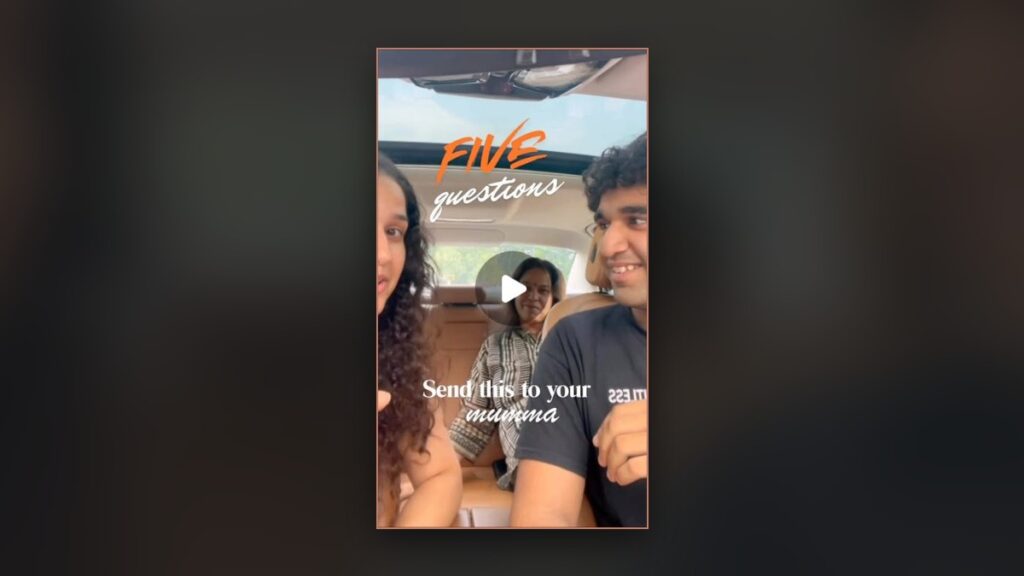
I have noticed something and I do not think it is a coincidence.
The honest conversations in my family do not happen at the dining table. They happen in the car. On the way back from somewhere, usually at night, usually when nobody planned anything.
This is not a family quirk. Ask around and almost everybody has a version of it. Some people’s version is the kitchen while cooking. Some people’s is a walk. Some people’s is the ten minutes after the lights go off when nobody can see anyone’s face. But the car comes up more than anything else.
There is a reason, and once you know it you can use it on purpose.
Eye contact is not always closeness
We have absorbed the idea that looking someone in the eye is what sincerity looks like. For declarations, that is true. For disclosures, it is often the opposite.
Direct eye contact raises the stakes of a conversation. It makes the other person very aware that they are being watched while they decide what to say. That awareness is exactly what stops people from saying the unpolished version of a thing, and the unpolished version is the one you actually wanted.
Sitting side by side removes that pressure without removing the person. You are together, you are pointed the same way, and there is a perfectly respectable place to put your eyes. If the conversation gets heavy, nobody has to perform a facial expression about it. If it gets too heavy, either of you can end it by looking out of the window, and nobody has to name that they ended it.
Therapists have known this for a long time, which is why walking sessions exist and why a lot of work with teenagers happens over a game or a drawing rather than across a desk. Children look away when they are thinking hard. So do adults. We just get better at hiding it.
The car also has an exit
The second thing the car gives you is a time limit that nobody had to negotiate.
A conversation at the dining table is open-ended, which sounds generous and is actually frightening. There is no natural end, so starting it means committing to something of unknown size. A car ride is twenty-five minutes. Your mother knows that. You know that. The conversation cannot metastasise into an evening.
That container is what makes the risk tolerable. She can say a true thing knowing that the true thing will be over by the time you park, and that neither of you will be expected to keep going.
If she wants to continue, she will find a reason to sit in the car for four extra minutes after you arrive. That is the signal. Do not turn the engine off too quickly.
The five questions, and why they go in that order
The set I posted for mothers is deliberately sequenced. Here is the thinking.
Mumma, when you were my age, what were you like as a teenager?
This is first because it is the safest. She is not being asked about herself now, she is being asked about a person she used to be. Distance makes it easy. Almost everybody can answer this one, and answering it warms up the part of her that is used to being asked only about logistics.
What’s one thing you always wanted to do but never got the chance to?
This is the one that usually surprises people. My mother’s answer was interior design. Interior decoration karni thi mujhe. I have known her my entire life and I did not know that.
Be careful with the temptation that follows. The instinct is to immediately say “you can still do it, I’ll help you sign up”. Resist it for at least a few minutes. She is not presenting a problem for you to solve. She is telling you something about who she was. Solving it too fast is a way of not listening to it.
When you were a kid, who did you talk to when you were sad?
This one goes further back and often produces the longest answer. It also tells you, indirectly, what she learned about whether sadness was a thing you were allowed to hand to somebody. A lot of women of that generation will say “nobody” or name a cousin or a neighbour rather than a parent. That answer explains a great deal about how she has handled your sadness.
I know you as the person who is always trying to do every single thing for everyone. Besides that, what’s one very important thing about you that I still don’t know?
This is the actual question of the set. The preamble is not padding. It is there because you have to acknowledge the role before you can ask her to step outside it. Without that first sentence, the question sounds like an accusation that she has been hiding something. With it, it sounds like an invitation.
And the last one. Mumma, aaj kya banaya hai?
People think this one is a joke. It is not, or not only.
After four questions that asked her to be a person, this one hands her back her competence. It is the register you normally speak in, and returning to it at the end tells her the conversation is finished and nothing has changed between you. Ending on the familiar is how you make the unfamiliar part safe to have done.
She has probably not been asked in a while
There is a thing that happens to mothers in Indian households where, at some point, everybody stops asking and starts checking. “Khaana ban gaya?” “Doctor ke paas gaye?” “Bijli ka bill?”
These are not cold questions. They come from love. But they are all questions about function. Weeks can pass without anybody asking her a question whose answer would be about her rather than about a task.
When I asked my mother when the last time somebody asked how she was and genuinely wanted to know, her answer was essentially that nobody asks, and that a mother is the one who does the asking. That is not a complaint she would ever make out loud. It just fell out when there was a question shaped to catch it.
A few practical things
Do not announce it. “Mumma I want to ask you five questions” turns it into an interview and she will start performing for it. Just ask one, in the car, the way you would ask anything.
Do not put a phone in her face. If you want to remember it, write it down afterwards.
One question is a full attempt. You do not need to get through the list. Three of the five is a very good day.
Expect deflection on the second question especially. “Arre, kya faayda ab” is not a refusal. Wait. Do not fill the silence. She will usually answer about eight seconds after you think she is not going to.
And if she turns it around and asks you something back, answer it properly. The fastest way to close this door is to run an interview where only one person is exposed.
The point
You are not trying to fix anything. You are trying to find out one thing about your mother that you did not know, from a person who has spent twenty years being spoken to almost entirely in the imperative.
The car is the easiest room in the house for that. It just happens to have wheels.
The five questions are on the questions page, along with the ones for siblings and a few other people. Print them, screenshot them, whatever. Then put the phone down and drive.
What you have just read is psychoeducation: general information and reflection, written for a lot of people at once. It is not therapy, an assessment, or a diagnosis, and it is not advice about your particular situation. Reading it does not make us a practitioner and a client.
If you are carrying something heavy, please talk to a qualified mental health professional who can actually see you and your circumstances. And if you are in crisis or thinking about harming yourself, please do not start here. In India, Tele-MANAS is free and open 24 hours on 14416, in English and 20 other languages. Anywhere else, findahelpline.com has the number for your country.