
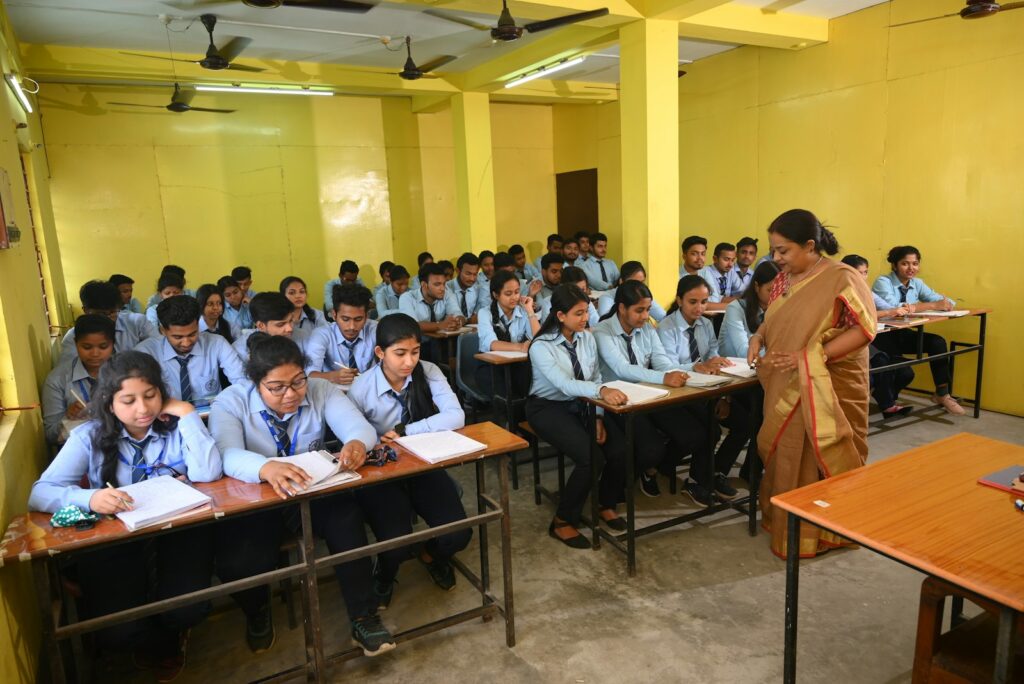
The bell has gone, but half the room is still in the corridor, on the bus, or inside a phone they have just put face down on the bench.
You know this moment better than I do. Bags thud, someone is finishing a sentence from the last class, someone else is staring at the board without seeing it. You can start teaching straight away, and sometimes you have to. But if you can spare three to five minutes, there is a gentler way in: give their bodies a minute to arrive in the room before you ask their brains to do the work.
Below are five openers I would hand to any teacher who asked. None of them need props, an app, a projector or movable furniture. They work with fixed benches and forty-five students. And none of them ask anyone to say anything personal out loud.
Why start with the body at all
A student who has just sprinted up three floors, or argued with a friend at the gate, or sat through a test, brings all of that in with them. It shows up in bouncing knees, hunched shoulders, jaws set tight, eyes on the door. Telling them to “focus now” asks the mind to switch gears while the body is still running the last thing.
An opener is a short pause between the outside and the lesson. I am not going to promise it will raise marks or fix anyone’s stress, and I would be wary of anyone who does. What it can do is give the room a shared, predictable minute that says: we are here now, and it is fine to land slowly.
Five ground rules before you start
These matter more than which opener you choose.
- Optional, always. Say it every time: “You can join in, or just sit. Both are completely fine.” Then mean it. No one gets called out for sitting it out.
- Private, always. Nothing is shared aloud. If there is any writing, it stays with the student. You do not collect it, read it, or ask about it.
- Short. Five minutes at the very most. Two or three is often better.
- Same slot, every class. When it happens at the same point each time, it stops feeling strange and starts feeling like part of the room.
- You do it too. Do it with them, not at them. Students watch whether you are actually doing it.
The five openers
1. Arrive in your seat (about 1 minute)
Good for: the very first time, or a class that has come straight from something loud.
Script, said slowly:
“Before we start, let’s take one minute to arrive. You can join in or just sit. If you like, put both feet flat on the floor. Notice the bench under you, how it holds your weight. Rest your hands on the desk or in your lap. You don’t have to close your eyes; you can just look at a spot on the desk. Let your shoulders drop a little, if they want to. That’s it. We’re here.”
Then pause for about ten seconds of quiet and begin the lesson.
2. What can you hear? (about 1 to 2 minutes)
Good for: restless rooms, after lunch, the class before a break.
“For the next minute, we’re just going to listen. You can do this or just rest. See if you can notice three sounds. Maybe something far away, outside the building. Maybe something in the corridor. Maybe something very close, inside this room. You don’t need to name them to anyone. Just notice.”
After a minute: “Okay. Thank you. Let’s begin.” Some students will smile at the fan or the traffic. That is fine. Listening gives attention somewhere neutral to go, which is easier for many people than being asked to notice their own breathing.
3. One word, folded away (about 2 minutes)
Good for: before a test, after a holiday, or any day the room feels heavy. (Around exams, my guide on where exam stress shows up in the body is one you can pass on to students.)
“Take a scrap of paper or the back page of your notebook. Write one word for how you arrived today. Anything at all: tired, fine, hungry, nervous, blank. No one will see this, not me, not your neighbour. Now fold it, or close the page. You can keep it, throw it away later, or ignore it. You’ve noticed how you came in. That’s enough.”
Say clearly, before they write, that you will not collect it. Never ask anyone to read theirs out, even as a joke, and never walk around looking at pages during this one.
4. Shake it out (about 2 minutes)
Good for: early mornings, long double periods, after a lot of sitting.
“Let’s wake the body up a little. You can stand if you want, or stay seated; both work. Roll your shoulders back slowly, three times. Now forward, three times. Stretch your fingers wide, then make a loose fist, and open again. Press your palms together in front of you for five seconds, and let go. Last one: gently turn your head to look over one shoulder, then the other. Okay. Sit comfortably.”
Keep every movement doable from a seat, so a student with an injury, a disability, or simply a long skirt and a tight bench is not left out. And skip anything that involves touching each other.
5. A longer breath out, or a spot on the board (about 1 to 2 minutes)
Good for: once the class is used to openers and trusts that they really are optional.
“This one is about breathing, and it’s optional in a slightly different way. If paying attention to your breath feels uncomfortable for you, and for some people it does, just look at this dot on the board instead and let your eyes rest there. If you’d like to try the breathing: breathe in through your nose while I count to four. Now breathe out slowly while I count to six. Let’s do that four more times.”
Count softly. Do not tell anyone they are doing it wrong. Some people find that focusing on breathing makes them more uneasy rather than less, which is why the alternative is built in and offered first. I have written more about that in what to try when “just breathe” makes it worse.
A few things that tend to come up
Someone giggles. Let it pass. Smile, keep your voice steady, and carry on. Openers can feel awkward the first few times, for the teacher too, and that awkwardness usually fades as the opener becomes familiar.
Someone refuses every time. That is allowed, and it is part of the design. A student who sits and watches is still getting a calm minute.
You run out of time. Do the one-minute version, or skip it that day. A rushed opener is worse than none.
Choosing which to use. Pick one and repeat it for a week or two before trying another. Familiarity is part of what makes it settling.
What these openers are not
They are not counselling, therapy or screening, and they do not replace your school counsellor. If a student seems distressed during or after an opener, or tells you something worrying, follow your school’s own procedure and involve the counsellor, the way you would on any other day. With students under 18, your institution’s consent and safeguarding processes come first.
If you want official material to read alongside this, the Ministry of Education’s Manodarpan site has advisories written for teachers, principals, parents and students, and a free helpline for students on 844 844 0632. For anyone in crisis, Tele-MANAS is free and open 24 hours on 14416.
If you want to take this further
These five are free to use, adapt and share in your staffroom. If your school, college or team would like something longer, I run body mapping sessions for groups: an hour or so where people draw where stress and calm show up in their bodies, with the same rules of choice and privacy you have just read. Nothing personal has to be said aloud there either. If you are curious about the format, timings and room set-up, I have written up what a body mapping workshop for a college looks like.
Further reading
- Ministry of Education, Manodarpan: https://manodarpan.education.gov.in/
- PIB press release on the launch of Manodarpan (21 July 2020): https://pib.gov.in/PressReleasePage.aspx?PRID=1640208
- Ministry of Health and Family Welfare, note on Tele-MANAS (February 2025): https://static.pib.gov.in/WriteReadData/specificdocs/documents/2025/feb/doc202527497201.pdf
What you have just read is psychoeducation: general information and reflection, written for a lot of people at once. It is not therapy, an assessment, or a diagnosis, and it is not advice about your particular situation. Reading it does not make us a practitioner and a client.
If you are carrying something heavy, please talk to a qualified mental health professional who can actually see you and your circumstances. And if you are in crisis or thinking about harming yourself, please do not start here. In India, Tele-MANAS is free and open 24 hours on 14416, in English and many Indian languages. Anywhere else, findahelpline.com has the number for your country.