
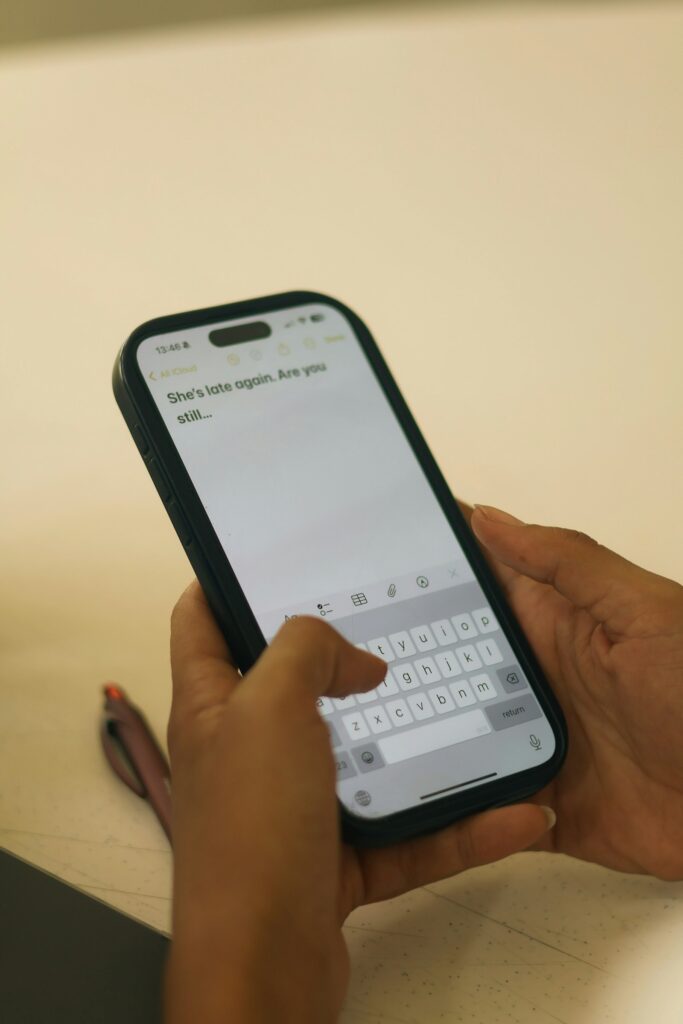
Your phone buzzes on the desk, and before you have even turned it over, your shoulders have already answered.
Try noticing it today. A message comes in, or you just think one might, and something between your ears and your collarbones tightens and lifts a few millimetres. Most of us only notice at the end of the day, when the top of the back feels like a coat hanger.
There’s a reason this particular spot gets the job.
The muscle that holds your shoulders up
The upper trapezius is a broad, flat muscle that runs from the base of your skull out to the tip of each shoulder. When you brace for something, it shortens and lifts. You use it to shrug, to carry a heavy bag, and, it turns out, when you’re under mental pressure.
In a lab study of 62 women in Sweden, researchers measured the electrical activity of this muscle while people did stressful mental tasks: mental arithmetic, and a colour-word test where you have to name the ink colour of a word that spells a different colour. Both tasks raised activity in the upper trapezius. Blood pressure, heart rate, stress hormones and how stressed people said they felt went up too. And when the mental task was piled on top of a physical shoulder task, the muscle worked harder than with the mental task alone.
Think about that last part next time you’re hunched over a laptop answering messages.
Waiting is enough
The finding I find most useful is about anticipation. In a study of 64 adults in the Netherlands, people sat waiting for a mild electric shock that could arrive at an unpredictable moment. Their upper trapezius activity rose above baseline while they waited, before anything had happened. After the shock, activity came down, but it had not gone back to baseline two minutes later.
So the body seems to brace for the possibility of something, and then takes a while to let go. A notification works on a smaller scale, but the shape is familiar: something might need you, and the shoulders get ready.
I want to be honest about the limits here. These are lab studies with small groups and short tasks. In the Dutch study, how tense the muscle was didn’t line up neatly with how stressed people said they felt. And one study of 21 women found that social stress did not change how the trapezius fired during a very precise shoulder task, which the authors noted was different from most earlier studies. The pattern is common in research, though not universal, and it depends on what the person is doing. None of these studies shows that stress causes shoulder pain.
Is it a startle?
Mostly not. The startle reflex, the jump you do at a sudden loud bang, is very fast and involuntary, and in humans the neck muscles respond in a fraction of a second, before you could choose anything. Fear makes that response bigger, according to Michael Davis’s work on startle.
A phone buzz usually isn’t loud enough for a full startle. What happens is closer to an alerting reaction: your attention turns towards the sound, and your body gets ready in case the message is the one you’ve been dreading or waiting for. Over months of notifications, that readiness can become a habit. The buzz arrives, the shoulders go up, and you never decided anything.
There’s also a bit of evidence that the alerts themselves pull at us. In one study of 221 Canadian university students, people spent one week with phone alerts on and one week with them off and the phone out of sight. With alerts on, they reported more trouble paying attention and more restlessness. That was self-report, from students, over a week each, and it says nothing about shoulders. But it fits with the general sense that every buzz is asking for a little piece of you.
The 60-second shoulder check
Think of this as a noticing exercise. It won’t fix pain, and it isn’t meant to. What it can do is show you how often your body braces without asking you first.
For one day, every time your phone buzzes, do this before you look at the screen:
- Notice. Where are your shoulders right now? Close to your ears, level, pulled forward? Don’t correct anything yet. Just find them.
- Drop. Let them fall away from your ears. You don’t have to push them down hard. Imagine them getting heavier.
- Breathe out. One slow, long breath out, a little longer than the breath in. You might feel the top of your back soften on the way out, or you might not. Either is fine. If paying attention to your breath tends to make you more anxious, skip this step; there are other ways to settle in when “just breathe” makes it worse.
- Repeat. Next buzz, do it again. That’s the whole thing.
The whole check takes under a minute. Then read your message.
At the end of the day, ask yourself two questions. Were your shoulders already up most times you checked? And was there a kind of notification, or a particular person, where they rose higher? You might find your body has opinions about your group chats that you hadn’t put into words yet.
If you’d like to make it easier, put the phone face down a little further away, so there’s a beat between buzz and reach. That beat is where the check lives.
When it’s more than tension
Please don’t use this post to explain away pain. If you have shoulder or neck pain that stays, keeps coming back, wakes you up at night, or comes with numbness, tingling or weakness, see a doctor. Tension and worry can sit in the body, and real physical problems can too, and only someone who can examine you can tell which is which. I wrote about the frustrating middle ground, when tests come back clear and you still hurt, in The doctor said nothing is wrong.
What your shoulders might be telling you
Shoulders that live up by your ears belong to a body doing its best to be ready, and there is nothing shameful in that. The question I’m more curious about is: ready for what? Sometimes the answer is obvious: exams, or a manager who messages at midnight. Sometimes it takes a while to see.
Sources
- Lundberg, U., Kadefors, R., Melin, B., Palmerud, G., Hassmén, P., Engström, M., & Dohns, I. E. (1994). Psychophysiological stress and EMG activity of the trapezius muscle. International Journal of Behavioral Medicine, 1(4), 354-370. doi.org/10.1207/s15327558ijbm0104_5
- Luijcks, R., et al. (2014). Experimentally induced stress validated by EMG activity. PLoS ONE, 9(4), e95215. Open access
- Stephenson, J. L., & Maluf, K. S. (2010). Discharge behaviors of trapezius motor units during exposure to low and high levels of acute psychosocial stress. Journal of Clinical Neurophysiology, 27(1), 52-61. Free on PMC
- Davis, M. (1999). The startle response. Popular-version paper, 138th Meeting of the Acoustical Society of America.
- Kushlev, K., Proulx, J., & Dunn, E. W. (2016). “Silence your phones”: Smartphone notifications increase inattention and hyperactivity symptoms. Proceedings of CHI ’16, 1011-1020. PDF
What you have just read is psychoeducation: general information and reflection, written for a lot of people at once. It is not therapy, an assessment, or a diagnosis, and it is not advice about your particular situation. Reading it does not make us a practitioner and a client.
If you are carrying something heavy, please talk to a qualified mental health professional who can actually see you and your circumstances. And if you are in crisis or thinking about harming yourself, please do not start here. In India, Tele-MANAS is free and open 24 hours on 14416, in English and many Indian languages. Anywhere else, findahelpline.com has the number for your country.