
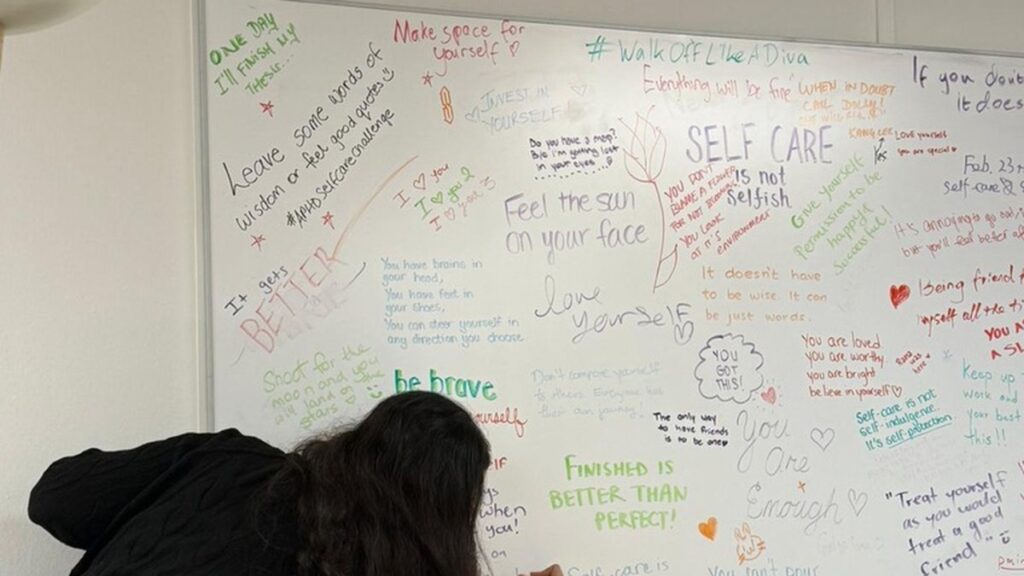
Try saying something kind to yourself in whatever language you grew up speaking. Out loud, in your own voice.
Not a proverb, and not a line from a film. Not something you would say to comfort somebody else, either, because that part most of us can do without thinking. A sentence that is only for you, and that means roughly this: I am allowed to find this hard, and I am not going to make it worse by being cruel about it.
Most people I have asked cannot produce that sentence without it arriving as a translation.
That is the thing I did not expect to run into when I came back to India to practise. Not a clinical problem. A vocabulary one.
I assumed this part would be easy
I did my Master’s in Counselling Psychology and Global Mental Health in Canada. Most of my training in self-care, boundaries, scope of practice and clinician wellbeing came out of that context: the readings, the supervision model, the vocabulary.
And I grew up here. So when I came back to practise, the part I was worried about was clinical. Would I be good enough. Would supervision be hard. Would I know what to do when somebody said something I had not read about.
The part I was not worried about at all was the culture. How would I not know India. I am from here. I know what a family dinner sounds like, I know how much weight a sentence about what people will say can carry, I know the difference between what is said and what is meant.
What I did not account for is that knowing a culture as a daughter is not the same as meeting it as a practitioner. As a daughter, you are inside the water. As a practitioner, you are suddenly being asked to notice the water, including the parts of it that are inside you.
And the first thing I noticed is that I did not know how to be kind to myself here.
The pressure to be occupied
The clearest difference is that here, being busy is not a schedule. It is a moral category.
There is a very steady, very loving pressure to be doing something. To be useful. To have something to show for the day. Rest is permitted when it is earned and preferably when it is visible that it was earned. Sitting still, with nothing in your hands, for no stated reason, is slightly suspicious, and the suspicion is not only other people’s. It is mine.
So my day fills. Not with anything bad. Clients, supervision, reading, notes, workshops, the content, the admin that nobody warns you about. All of it is work I chose and work I want. And the thing that gets moved to the end of the list, every single time, is the thing that has no deliverable attached to it.
Self-care does not generate a deliverable. That is precisely what makes it so easy to postpone in a culture that is this good at producing them.
We are generous outward and strict inward
Here is the part that I think gets written about badly, so I want to be careful with it.
We are warm. Genuinely, structurally warm. Somebody is always feeding somebody. A neighbour will take your parcel, a cousin will come to the hospital at two in the morning, a stranger at a wedding will remember your name. The capacity for care in our families is enormous and it is not performance.
And we also expect a great deal. From everyone. We expect a great deal from our children, from our siblings, from our partners, from ourselves. The same system that produces that warmth also produces a very high and very internalised standard, and the standard is applied to the self more harshly than it is applied to anybody else.
I notice this in myself constantly. I will extend an enormous amount of patience to a client who missed a session, and almost none to myself for sending one email late.
The easy thing to do with this observation is to blame collectivism, and I do not think that holds up.
In 2008 Kristin Neff, Kullaya Pisitsungkagarn and Ya Ping Hsieh compared self-compassion across the United States, Thailand and Taiwan. If the story were simply that individualist cultures are kind to themselves and collectivist ones are not, you would expect the United States to come out on top. It did not. Thailand had the highest self-compassion, Taiwan the lowest, and the United States sat in between.
The authors’ reading of it is the useful part. Interdependence by itself does not produce harsh self-criticism. What matters is what a culture does with interdependence. Thai socialisation, in their account, draws on a Buddhist frame in which suffering and imperfection are ordinary, and on krengchai, a strong reluctance to disturb another person with direct criticism. Taiwanese socialisation, in the same study, made more explicit use of shame as a tool for moral instruction.
Same broad category of culture. Opposite result.
India was not in that study, which is part of why I am writing this rather than citing it as settled. But the finding tells me where to look. Not at whether we are collectivist, because we are, and I am not interested in treating that as a defect. At what we do with it. And what we do with it, a lot of the time, is scrutiny.
There are fewer words
This is the thing I keep coming back to.
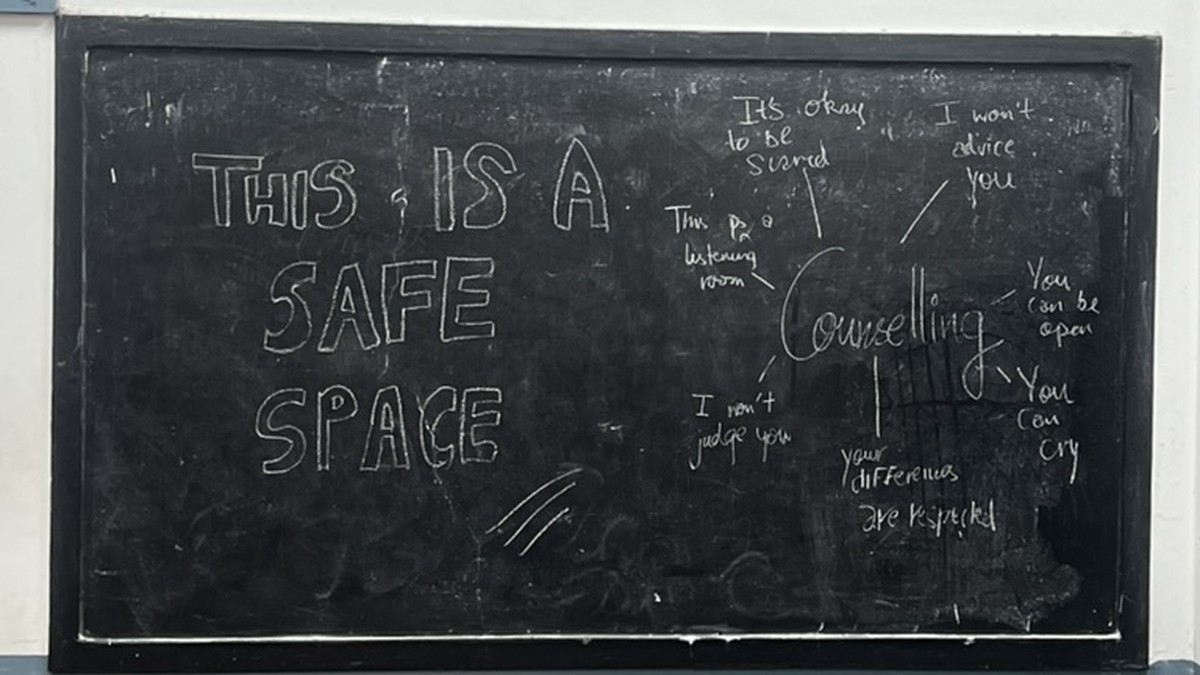
It is not that the concept of self-compassion is absent here. It is that the everyday vocabulary for it is thin, and the vocabulary for everything adjacent to it is extremely rich.
We have beautiful, precise, well-worn language for duty. For patience. For adjusting. For bearing something without saying that you are bearing it. For sacrifice, and for being the one who holds everything together. That vocabulary is in constant circulation. A twelve year old can use it correctly.
Now try to say, in the language you actually think in, something that means I am allowed to find this hard, and I am not going to make it worse by being cruel about it. For most of us it comes out either as a cliché, or as a translation, or as something that sounds like it belongs in a greeting card.
So the sentence I asked you to try at the start of this sits outside the register we use with each other, and well outside the one we use with ourselves. If it felt awkward in your mouth, that is not a finding about you. It is a finding about how little practice the language has had. It is the same reason a sibling will look at a direct question and call it AI: we have never spoken to each other in that register either. I have written about that version of the same problem before.
A missing register is not a missing capacity. But a missing register does make the thing much harder to practise, because every time you try it, you hear how strange it sounds.
What self-compassion actually is, briefly
Since the term gets used loosely, it is worth being precise about what the research means by it.
Neff’s model, which is what the Self-Compassion Scale measures, has three components, each with a shadow:
Self-kindness, as against self-judgment. Treating yourself with warmth when you fail, rather than with criticism.
Common humanity, as against isolation. Recognising that failing and struggling are part of the shared human experience, rather than evidence that something is uniquely wrong with you.
Mindfulness, as against over-identification. Being aware of your painful feelings with some balance, rather than being swallowed by them or suppressing them.
And three things it is not, which matter more in our context than in most.
It is not self-pity. Self-pity collapses inward and loses sight of everyone else. Common humanity does the opposite.
It is not self-indulgence. This is the objection I hear most often and the one I find least convincing. Neff’s more recent work, in Fierce Self-Compassion, makes the point that self-compassion has a fierce side alongside the tender one. It protects, it provides, and it motivates. Telling yourself the truth about something you need to change is a self-compassionate act. Telling yourself the truth cruelly is just cruelty with good aim.
It is not lowering the bar. Among doctoral psychology trainees, Richardson, Trusty and George found in 2018 that self-critical perfectionism predicted higher depression and higher burnout, and that self-compassion partly explained the link. The self-critical trainees were not out-performing anybody. They were burning out faster.
Self-care is not the same as taking fewer clients
I want to say this clearly because I think it is the real barrier for most people I know in this field.
When trainees and early-career counsellors in India hear “self-care”, what many of them hear is: work less, earn less, see fewer people, be less available. For someone who is building a practice, who is unpaid or barely paid during practicum, who has family watching to see whether this career was a reasonable decision, that is not advice. That is a threat.
So let me put it differently. Self-compassion is not time taken away from the work. It is the condition that makes the work possible to keep doing.
A depleted counsellor is not a noble counsellor. A depleted counsellor is a less present one. Attention narrows, patience thins, the fifth client of the day gets a worse version of you than the first, and you are the last person who will notice because you are inside it.
There is a version of self-care that actually makes this worse, and Susannah Coaston named it well in 2017: when self-care plans are written like self-improvement plans, they turn into one more register where you can fail. One more list to not complete. One more thing to feel behind on. Her argument is that self-compassion has to sit underneath self-care, as the ground, rather than beside it as another task.
That reframe is what finally made this usable for me. I stopped treating self-care as a separate block of time I had to find, which I never found, and started treating self-compassion as something that happens inside the work, in the gaps that already exist.
Three things I actually do
Not a programme. Three specific things, two from Neff and one from elsewhere.

One. The Self-Compassion Break, in my own language.
Neff’s version has three steps, which map onto the three components. You acknowledge the difficulty: this is a moment of suffering. You locate yourself in company: suffering is part of life, or I am not alone in this. Then you offer yourself something, often with a hand on your chest, along the lines of may I be kind to myself.
The instruction that matters most, and that is in her own guidance, is to find your own wording. Ask what you actually need to hear.
For me that meant doing it in Hindi, and accepting that it would sound strange for a while. It did. It sounded borrowed and slightly theatrical and I did not like hearing it in my own voice. It sounds less strange now. That is the whole point of a register. It is built by use.
Two. The question I ask after a session that went badly.
Neff has an exercise about how you would treat a friend. I use a narrower version of it.
After a session I feel bad about, I write down what happened in two or three sentences, as plainly as I can. Then I ask: if a peer described exactly this to me in supervision, what would I say to them?
The answer is never what I was saying to myself. It is usually something like, that sounds like a hard session, you were working with very little information, here is the one thing I would try next time. The gap between those two responses is the measurement. It tells me how much of what I am feeling is useful information about my practice and how much is just the habit of scrutiny.
Then I say the second version to myself. Out loud, if I can manage it.
Three. Naming which system I am in.
This one is not Neff. Paul Gilbert’s compassion focused therapy works with a model of three emotion regulation systems: a threat system, a drive system, and a soothing or affiliative system.
I find this enormously clarifying in an Indian context, because we are extremely well trained in two of the three. Drive is our native language. Achievement, striving, the next thing, the next qualification. Threat we know too, intimately, in the form of comparison, consequence, and the constant background question of what other people will think. The soothing system is the one almost none of us has been coached in.
So before I decide what I need, I try to name which one is running. Tiredness that comes from drive needs something different from tiredness that comes from threat. If I am in threat, more effort is not the answer and is usually the thing making it worse. Gilbert’s own entry point here is slow, steady breathing, which sounds too simple to be a clinical technique and is in the literature for a reason.
Naming the system takes about four seconds and it changes what I do next more reliably than anything else on this list.
A note about days
Self-compassion looks different on different days.
Some days it is a practice, with words and a hand on the chest. Some days it is cancelling one thing. Some days it is doing the work anyway and simply not narrating it cruelly while you do it. Some days the most self-compassionate available act is to eat properly and go to bed, and nothing about that is profound.
And some days you will not manage any of it, and the appropriate response to that is not a second layer of self-criticism about having failed at self-compassion. That loop is real, and recognising it is itself part of the practice.
If this piece reads like I have resolved it, I have not. I am a counsellor in training, I am new to practising in a country I thought I already understood, and I am still the person who extends more patience to everybody else.
I know I am not alone in this
There are a great many of us. Students in psychology programmes, trainees in practicum, early-career counsellors in India and in a lot of other places, all working inside systems that take our output seriously and our capacity for granted.
I think self-compassion is chronically under-emphasised in how we are trained, even now, even in programmes that are otherwise thoughtful about everything else. It gets one lecture, or a line in a wellness email, and then we move on to the clinical material, which is treated as the real content.
So I would rather say it here, plainly, than assume somebody else is saying it.
If you are in this field and you have noticed lately that you are not as present as you used to be, that the sessions are blurring, that you are listening with less of yourself in the room, please take that as information rather than as a verdict on you. That is not a character finding. It is a capacity reading, and capacity is a thing you can act on.
We hold that space for so many people. It is worth noticing how rarely we hold the same space for ourselves.
I am still learning the words for it. I am fairly sure that is allowed.
Further reading
- Self-Compassion and Self-Construal in the United States, Thailand, and TaiwanNeff, Pisitsungkagarn & Hsieh, Journal of Cross-Cultural Psychology, 2008. The study behind the point that interdependence does not automatically produce self-criticism.
- Trainee wellness: self-critical perfectionism, self-compassion, depression, and burnout among doctoral trainees in psychologyRichardson, Trusty & George, Counselling Psychology Quarterly, 2018.
- Self-Care Through Self-Compassion: A Balm for BurnoutSusannah C. Coaston, The Professional Counselor, 7(3), 2017. On why self-care plans written like self-improvement plans backfire.
- The Self-Compassion BreakKristin Neff’s own guided version of the exercise, including the instruction to find your own wording.
- The Compassionate Mind FoundationPaul Gilbert’s organisation. Starting point for compassion focused therapy and the three systems model.
What you have just read is psychoeducation: general information and reflection, written for a lot of people at once. It is not therapy, an assessment, or a diagnosis, and it is not advice about your particular situation. Reading it does not make us a practitioner and a client.
If you are carrying something heavy, please talk to a qualified mental health professional who can actually see you and your circumstances. And if you are in crisis or thinking about harming yourself, please do not start here. In India, Tele-MANAS is free and open 24 hours on 14416, in English and 20 other languages. Anywhere else, findahelpline.com has the number for your country.