
Someone says “just breathe”, you try, and suddenly every breath feels too short, too loud, or not quite deep enough.
If that happens to you, you are not bad at calming down. Breathing exercises help a lot of people, and they may help you on another day. But for some people, in some moments, turning attention onto the breath is like being asked to stare at the very thing that already feels wrong. The breath becomes one more thing to get right.
So here are six ways to settle that start somewhere else: your feet, your hands, your skin, your ears, the room, and movement. If you’re reading this while it’s happening, go straight to the list below. The explanation can wait.
If you feel unsafe, or this feels different from the anxiety you know, please don’t wait. In India, call Tele-MANAS on 14416 or 1800-89-14416. It’s free and open 24 hours. In an emergency, call 112.
Six ways to settle that don’t use your breath
Pick one. You don’t need to do all six, and you don’t need to do them in order. Give whichever you choose a minute or two before deciding whether it helps.
1. Feet
Press both feet flat into the floor. Push down as if you were trying to leave footprints, hold for a slow count of five, then let go. Do it a few times. Notice the floor pushing back. If you’re standing, shift your weight slowly from one foot to the other.
2. Hands
Hold something with a texture: a cushion with a seam, a key, a rough stone, the edge of your sleeve. Run your thumb over it and pay attention to exactly what it feels like. Ridged or smooth? Warm or cool? Hard edges or soft? Your attention needs somewhere solid to land, and the small details of an object give it that.
3. Warmth
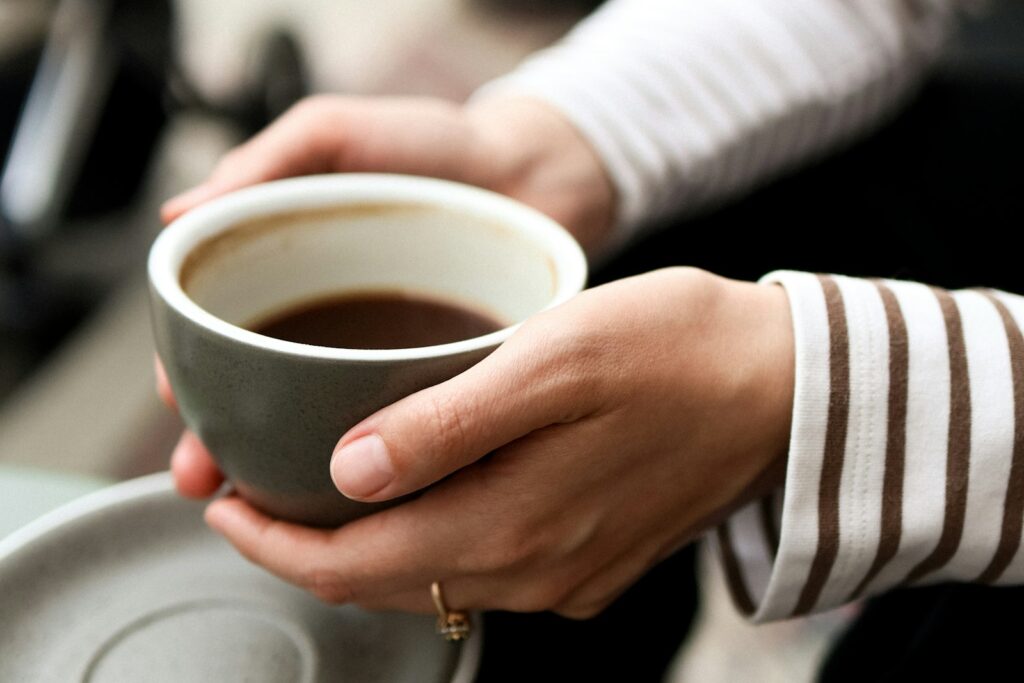
Wrap both hands around a warm cup of tea or water and just hold it. Feel the heat move into your palms. A warm shawl around your shoulders or a hot water bottle on your lap can work the same way.
Some people prefer something cool instead, like running cool (not icy) water over the insides of your wrists for a few seconds, or holding a cold glass. Keep it mild. If you have a heart condition, skip the cold version altogether: sudden cold can make the heart race and blood pressure rise, which is why heart charities advise caution with cold water (British Heart Foundation). Please don’t use ice on your face or plunge into cold water to stop anxiety.
4. Sound
Name three things you can hear. Say them out loud or in your head. A fan. Traffic. Someone’s pressure cooker two floors down. Then try to find one more sound, the quietest one in the room. Listening outward gives your mind a job that has nothing to do with your chest.
5. Naming
Say out loud what is around you, plainly, like a list. “Blue chair. Window. Charger cable. My bag on the floor.” You might know a version of this called 5-4-3-2-1, where you name five things you can see, four you can touch, three you can hear, two you can smell and one you can taste. It’s widely used and simple, and plenty of people find it helpful, though I haven’t found a trial that tested it on its own. Use whichever version feels easier.
6. Moving
Get up and walk, even if it’s only to the end of the corridor and back. Or shake out your hands hard for ten seconds, like flicking water off them, then let them hang. Roll your shoulders, then let them drop (there’s more on that in why your shoulders go up when your phone buzzes). Movement can give that buzzing, restless energy somewhere to go.
If none of these help and this keeps happening, please talk to a qualified mental health professional. You deserve support that fits you.
Why the breath doesn’t work for everyone
I want to be fair to breathing first. In one randomised study, people who did five minutes a day of exhale-focused breathing, sometimes called cyclic sighing, for a month saw bigger improvements in mood than people who practised mindfulness meditation (Balban et al., 2023, Cell Reports Medicine). Those were healthy volunteers, not people in the middle of a panic, but it shows that the breath can be a good door for many people.
It just isn’t the right door for everyone, every time. There are a couple of reasons that might be.
One is about how people read their own breathing. In a lab study, researchers asked 60 adults to notice tiny changes in how hard it was to breathe (Harrison et al., 2021, Neuron). The people with moderate anxiety were less accurate at detecting those small changes than the people with low anxiety, and less confident in what they felt. The researchers suggest this kind of mismatch could feed a loop where body sensations and anxiety push each other along. It was a small study of healthy volunteers, not people with panic disorder, so I hold it lightly. It doesn’t show that focusing on your breath makes anxiety worse. (If sensing what’s going on inside is hard for you in general, I wrote about that in can’t tell what you’re feeling?) But it does suggest that for some anxious people, the breath may be a harder signal to read clearly, which might help explain why paying close attention to it doesn’t always feel calming.
Another is that turning inward isn’t comfortable for everyone. A review of 83 studies of meditation practices found that some people reported unwanted effects, and anxiety was the most commonly reported one (Farias et al., 2020, Acta Psychiatrica Scandinavica). That review covered meditation broadly, not breath focus specifically, and the studies varied a lot. Still, it’s a useful reminder that feeling more uneasy when you sit still and look inside is something researchers have documented. It isn’t a personal failing.
Coming back to the breath later
Going outward first, to your feet, your hands, the sounds in the room, gives your attention somewhere solid to stand. Once your body has settled a little, you may find the breath is easier to be with. You might simply notice it, without trying to change it. Or you might not want to, and that’s fine too.
You don’t have to master any technique. A few different doors are enough, so that when one is stuck, you can try another. Once you’re calmer, it can help to jot down which door worked; these journal prompts for anxious days include a few for the morning after.
This list is for ordinary anxious moments. It isn’t a treatment for panic attacks or panic disorder. If you’re having episodes that frighten you, keep coming back, or get in the way of daily life, please see a doctor or a qualified mental health professional.
Sources
- Balban, M. Y., et al. (2023). Brief structured respiration practices enhance mood and reduce physiological arousal. Cell Reports Medicine. https://hubermanlab.stanford.edu/publications/brief-structured-respiration-practices-enhance-mood-and-reduce-physiological-arousal
- Harrison, O., et al. (2021). Interoception of breathing and its relationship with anxiety. Neuron. Free version: https://www.ncbi.nlm.nih.gov/pmc/articles/PMC8691949/
- Farias, M., et al. (2020). Adverse events in meditation practices and meditation-based therapies: A systematic review. Acta Psychiatrica Scandinavica, 142(5), 374-393. https://pureportal.coventry.ac.uk/en/publications/adverse-events-in-meditation-practices-and-meditation-based-thera/
- British Heart Foundation. Cold water swimming. https://www.bhf.org.uk/informationsupport/heart-matters-magazine/activity/cold-water-swimming
What you have just read is psychoeducation: general information and reflection, written for a lot of people at once. It is not therapy, an assessment, or a diagnosis, and it is not advice about your particular situation. Reading it does not make us a practitioner and a client.
If you are carrying something heavy, please talk to a qualified mental health professional who can actually see you and your circumstances. And if you are in crisis or thinking about harming yourself, please do not start here. In India, Tele-MANAS is free and open 24 hours on 14416, in English and many Indian languages. Anywhere else, findahelpline.com has the number for your country.