
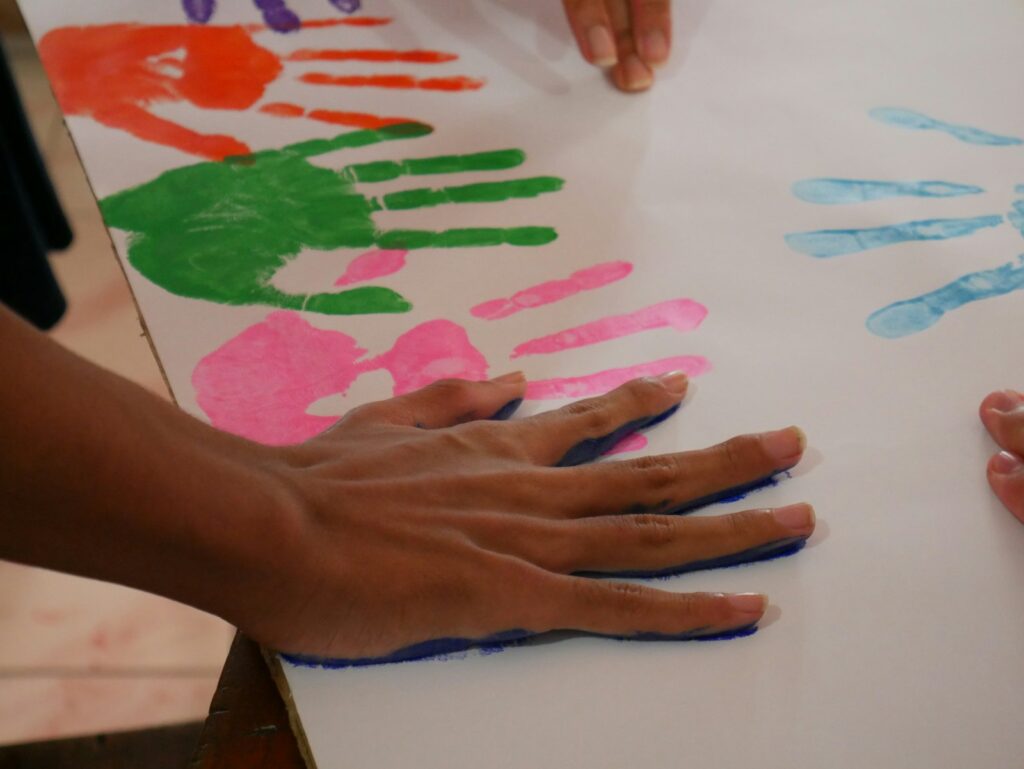
Body mapping started as a way to be seen. Women whose bodies were being talked about by everyone else lay down on large sheets of paper, had their outline traced life-size, and filled it in themselves.
I use a small, adapted version of this method in my own work. So I think I owe it, and you, an honest account of where it comes from and who built it. It wasn’t me, and it wasn’t anyone selling a wellness trend. It came from researchers, from a psychologist and a researcher in Cape Town, from an artist who carried it further, and above all from the people who made the first maps.
Before it had a name: research in the 1980s
The earliest recorded research use of whole-body mapping is usually credited to the researchers MacCormack and Draper. According to a 2016 systematic review by de Jager and colleagues, their fieldwork in 1985, published in 1987, compared how women in rural Jamaica and university students in the UK pictured identity and the reproductive system, using body maps.
The idea there was simple and quite radical. Instead of a researcher describing your body to you, you show the researcher how you understand it.
Cape Town: memory boxes, long lives and the Bambanani women
The form most people now think of as body mapping took shape in South Africa, among people living with HIV.
The de Jager review describes how it grew out of the Memory Box and Long Life work facilitated by clinical psychologist Jonathan Morgan and researcher Kylie Thomas at the University of Cape Town. At first, it had two purposes: it was used as therapy, and as a way to leave a legacy for children. It was also political. Body mapping was used to reduce stigma and to protest the lack of affordable antiretroviral medicines at the time.
The best-known maps came from the Bambanani Women’s Group, women living with HIV in Cape Town. In the early 2000s, South African artist Jane Solomon led a body mapping workshop with women who were receiving antiretroviral treatment through Médecins Sans Frontières. Their maps were published in Long Life: Positive HIV Stories, and you can read some of the story on MSF’s archive page. I am not reproducing the maps here. They belong to the women who made them, and they are worth looking at in their own context.
Solomon also wrote a facilitator’s guide, Living with X, adapting the Memory Box technique, and has taught the method in many countries. She is often named as the person who “invented” body mapping. That isn’t quite fair to her or to anyone else. She adapted and spread a method that Morgan, Thomas and the women of Bambanani had already been shaping. If you take one thing from this post, let it be that body mapping began with the people who painted their own bodies.
Toronto: body-map storytelling
Over the following years, researchers in other places picked the method up. One adaptation is close to my heart because it came out of my own university.
Between 2009 and 2012, Gastaldo and colleagues, based mainly at the Bloomberg Faculty of Nursing at the University of Toronto, used body mapping to tell the stories of undocumented Latin American workers in the Greater Toronto Area. They called their version body-map storytelling, and moved it from group therapy to one-to-one research.
Their guide makes a point I think about in every session. Each story had three parts: a first-person account in the person’s own words, the life-size map, and a key explaining what each mark meant to the person who made it. The map can’t be read without the key. A red spiral on the stomach might mean anger for one person, hunger for another, and a grandmother’s sari for a third. You don’t read a body map like a horoscope. The meaning belongs to the person who drew it.
I mention the University of Toronto connection because it is true and I find it moving. My work has no connection to or endorsement from the researchers who wrote that guide.
What the research does, and doesn’t, say
In 2016, de Jager and colleagues published a systematic review of body mapping. They looked at 22 articles, covering 19 studies published between 1992 and 2015. They found body mapping being used in research, in therapeutic settings, and in education. Education is where I bring it too: I offer it as a group session for colleges and teams, and I have described what a body mapping workshop looks like.
Their verdict was careful, and I want to repeat it carefully. They called body mapping promising. They also said that its benefits are largely anecdotal and have not been formally evaluated, and that it hasn’t been systematically compared with interviews or clinical measures. So nobody can honestly tell you that research proves body mapping heals anything. I certainly won’t.
The review also listed real cautions. Body mapping can feel intrusive. People may feel pressure to end their map on a hopeful note. Displaying maps in public can be inappropriate for vulnerable people. There are questions about who owns the artwork, about consent and confidentiality, and about distressing feelings coming up. It may not suit some kinds of trauma work. Even digital photos of maps can carry personal information.
These cautions shape how I work. My sessions are reflective and psychoeducational. They are not therapy, and they don’t go digging into traumatic memories. I have written more about that in what body mapping does not do.
A short reading list
All of these are free to read online.
- de Jager, Tewson, Ludlow and Boydell (2016), “Embodied Ways of Storying the Self: A Systematic Review of Body-Mapping”. The best single overview, and open access: read the review.
- Gastaldo, Magalhães, Carrasco and Davy (2012), Body-Map Storytelling as Research. A practical guide from the Toronto project, with clear sections on ethics: open the guide (PDF).
- MSF Access Campaign, “Body maps: art and memory”. The Cape Town story, told by MSF, whose programme provided the women’s treatment: read MSF’s page.
If you want to try it on yourself
You don’t need anyone’s permission to draw your own body. If you want to try, I wrote a step-by-step guide to making a body map at home. Whatever method you use, a few rules borrowed from the research ethics above can keep it kind:
- You own your map. It is yours to keep, change, fold up or throw away.
- Nobody interprets it for you. If someone tells you what your colours “mean”, you can thank them and ignore them. Write your own key.
- You can stop at any point. An unfinished map is still a map.
- Think before you post it. If you would regret a map being seen by your family, a colleague or a stranger in five years, keep it private. Photos can travel further than you expect.
- If it stirs up something heavy, put it down. Step away, do something ordinary, and talk to someone you trust or a qualified professional. Body mapping is not crisis care.
One last note. I don’t train or certify practitioners. If you are a psychology student curious about using it, start with the reading list and with the ethics, and with supervision from someone qualified in your own field.
Sources
- de Jager, A., Tewson, A., Ludlow, B., & Boydell, K. (2016). Embodied ways of storying the self: A systematic review of body-mapping. Forum Qualitative Sozialforschung / Forum: Qualitative Social Research, 17(2), Art. 22. https://doi.org/10.17169/fqs-17.2.2526
- Gastaldo, D., Magalhães, L., Carrasco, C., & Davy, C. (2012). Body-map storytelling as research: Methodological considerations for telling the stories of undocumented workers through body mapping. https://swenurse.se/download/18.4d2be9c71845c9b468385f9c/1668086536860/Body-map_storytelling_as_reseach_LQ.pdf
- MSF Access Campaign, “Body maps: art and memory”: https://20years.msfaccess.org/body-maps-art-and-memory
What you have just read is psychoeducation: general information and reflection, written for a lot of people at once. It is not therapy, an assessment, or a diagnosis, and it is not advice about your particular situation. Reading it does not make us a practitioner and a client.
If you are carrying something heavy, please talk to a qualified mental health professional who can actually see you and your circumstances. And if you are in crisis or thinking about harming yourself, please do not start here. In India, Tele-MANAS is free and open 24 hours on 14416, in English and many Indian languages. Anywhere else, findahelpline.com has the number for your country.