
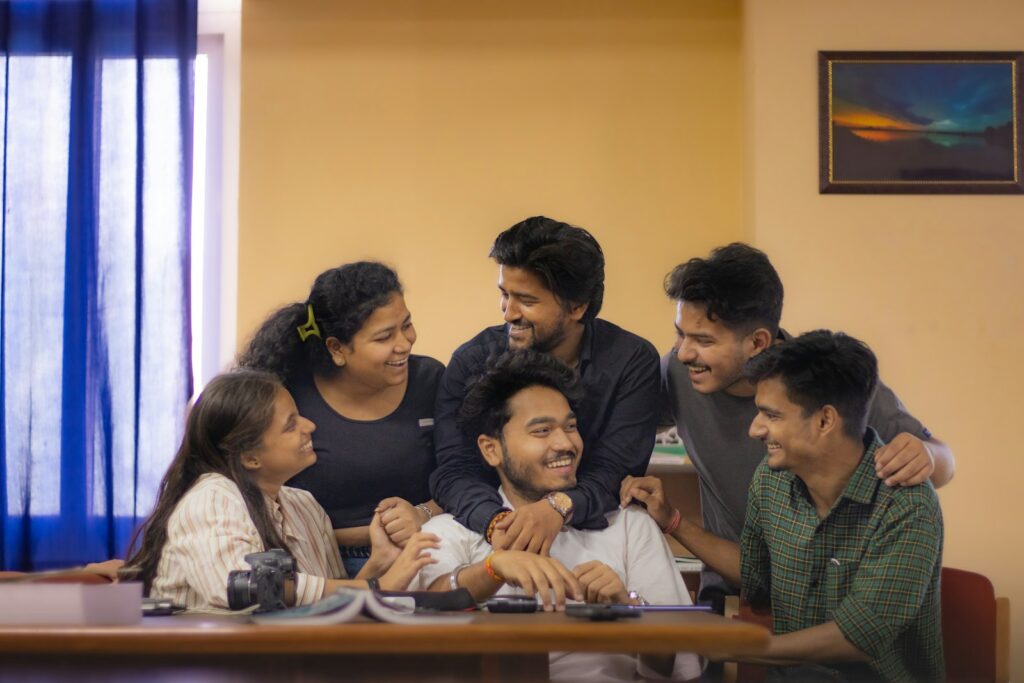
It is hard to scroll your phone when both your hands are holding markers.
That small, practical fact is part of why body mapping suits a room full of students. Instead of sitting through a slideshow about stress, they lay a large sheet of paper on the floor, draw an outline of a body, and colour in where stress actually shows up for them: the tight jaw before a presentation, the stomach that turns before results, the shoulders that never come down during exam month.
If you run a college, sit on a wellness cell, lead a student club or plan learning for a team, this post is a plain description of what a body mapping workshop with me looks like, what you would need to arrange, and, just as importantly, what it is not.
What body mapping is, in one paragraph
Body mapping is a creative, reflective method where people draw the outline of a body and fill it with what they notice: sensations, feelings, memories, colours, words. Reviews of the research describe it being used in research, therapeutic and educational settings, and note that how it is used varies a lot (de Jager et al., 2016). My workshops are educational and reflective. Nobody needs to draw well. Stick figures and scribbles are welcome, and each person decides what their map means. I ask questions; I don’t read anyone’s map back to them. There is a longer explanation on my body mapping page, and an honest list of what body mapping does not do.
Who I am, briefly
I am Tushti Hari. I studied sociology, psychology and Buddhism at the University of Toronto, I am completing my MEd coursework and a counselling practicum in Bengaluru, and I presented on body mapping at ICCP 2026. More than 60 people have done body mapping with me so far, including school students, adults in online and in-person groups, and practitioners from different fields.
I am not a therapist, psychologist or counsellor, and the workshop is not run as a clinical service.
The format
Every workshop is built around what you want for your group, so these are only the usual starting points. I agree the details with each host.*
- Length: usually 2 to 3 hours, with a short break.
- Group size: usually around 15 to 20 participants, small enough for everyone to be seen and large enough that nobody feels put on the spot.
- Where: in person in Bengaluru, or online for groups elsewhere in India.
- Language: English, Hindi or Punjabi, or a mix, depending on the group.
- Theme: you choose what you want your group to work on. I have run it on identity, stress and overwhelm, among other themes, and I am happy to shape it around what is going on for your students or team. For schools I keep to stress and self-compassion. Versions for teachers or parents can be discussed.
*Terms and conditions apply, and I share them when we plan your session together.
What happens in the room
Every group is a little different, and I shape the session with the host beforehand, so treat this as a rough outline rather than a fixed script:
- Arriving. Ground rules, consent, and a simple settling exercise. I make it clear that sharing is always optional and nobody’s map will be displayed without their permission.
- The outline. Each person draws a body outline, alone or with a partner tracing them on a large sheet, whichever feels comfortable.
- Mapping the theme. Prompts around the theme you chose. For stress, that might be a stressful week: where does it land, what colour is it, what shape, what does it want? People draw and write in silence for a while.
- Looking, not judging. A gentle reflection on what they noticed, in pairs or as a group, only for those who want to speak.
- A self-compassion tool. I close with one small, practical thing people can use when stress turns up again, and point to where support is available on campus and outside it.
- Taking it home. Maps belong to the people who made them.
What the room needs

- Space: enough clear floor or table space for large sheets of paper, one per person. A seminar room with movable tables or a hall with a clean floor works well.
- Materials: large sheets of paper and plenty of markers or crayons in many colours. The host arranges these.
- Privacy: a room where people walking past cannot see in, and where maps won’t be photographed or put on a wall without each person’s consent.
- For online sessions: each participant needs paper (A3 or a few A4 sheets taped together is fine), something to draw with, and a camera they are free to switch off.
What the host does
The workshop tends to go better when the host is involved beyond booking the room.
- Name one contact person who will be there on the day.
- Make sure the campus counsellor, or your referral route, is known and reachable during and after the session. Thinking about stress in the body can bring up feelings, and research on body mapping specifically notes that distressing emotions can surface and that facilitators need a plan for managing distress (de Jager et al., 2016). My plan for the day points to your people.
- Have helplines visible, including Tele-MANAS (14416, free, 24 hours, many Indian languages). The Ministry of Education’s Manodarpan initiative also runs a helpline for students and families on 8448440632 and has resources at manodarpan.education.gov.in.
- Keep it voluntary where you can. A room of people who chose to come is very different from a compulsory slot.
- For under-18 participants, your school’s own counsellor, safeguarding and consent processes apply, including parental consent where your policy requires it.
What this workshop is not
I’d rather say this plainly than have anyone surprised.
- It is not counselling, therapy or a clinical intervention.
- It is not screening. It does not identify “at-risk” students or assess anyone individually.
- It is not crisis support. If someone is in distress, your counsellor and helplines are the route.
- It does not replace your counsellor, your mental health policy or the trained professionals your institution works with.
- It is not psychological first aid training for staff.
Where it can fit alongside what you already do
On 25 July 2025, the Supreme Court of India issued interim guidelines on student mental health in educational institutions, in Sukdeb Saha v. State of Andhra Pradesh & Ors. (judgment PDF). Among other things, the guidelines ask institutions to have qualified counsellors or formal referral links, to display helplines such as Tele-MANAS, to train staff through certified mental health professionals, and to build mental health literacy into orientation and co-curricular programmes.
Please read the judgment yourself and take your own legal advice on what it requires of you. A body mapping workshop does not meet any of those requirements and does not count towards your counsellor or staff training duties. What it can do is sit alongside the wellbeing and co-curricular activities you are already planning, as one more way for students to think about stress that does not feel like another lecture. If you want a smaller start, I have also put together some five-minute class openers that teachers can use on their own.
Sources and further reading
- de Jager, A., Tewson, A., Ludlow, B., & Boydell, K. (2016). Embodied ways of storying the self: A systematic review of body-mapping. FQS, 17(2), Art. 22. https://qualitative-research.net/index.php/fqs/article/view/2526
- Supreme Court of India, Sukdeb Saha v. State of Andhra Pradesh & Ors., order dated 25 July 2025. https://api.sci.gov.in/supremecourt/2024/18489/18489_2024_3_1502_62660_Order_25-Jul-2025.pdf
- Manodarpan, Ministry of Education. https://manodarpan.education.gov.in
What you have just read is psychoeducation: general information and reflection, written for a lot of people at once. It is not therapy, an assessment, or a diagnosis, and it is not advice about your particular situation. Reading it does not make us a practitioner and a client.
If you are carrying something heavy, please talk to a qualified mental health professional who can actually see you and your circumstances. And if you are in crisis or thinking about harming yourself, please do not start here. In India, Tele-MANAS is free and open 24 hours on 14416, in English and many Indian languages. Anywhere else, findahelpline.com has the number for your country.