
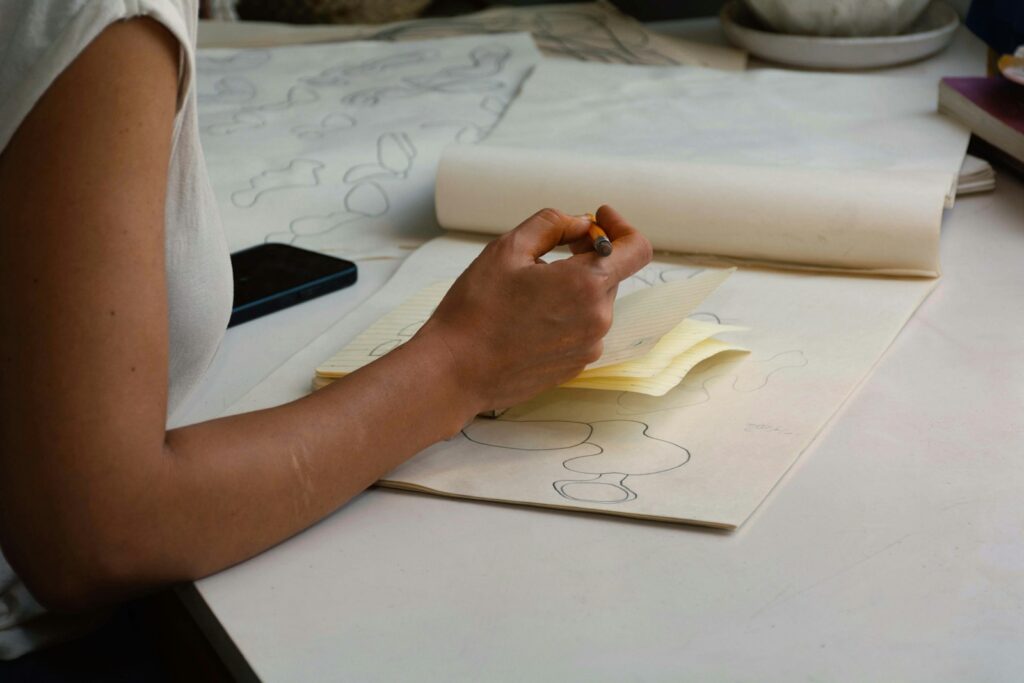
If the words “body mapping” make you picture an art class you are about to fail, you can put that worry down now: stick figures are welcome, and nobody grades the colours.
Here is the honest version of the hour: what we do, step by step, what you need on the table, and who I think should not book at all.
First, what body mapping is
Body mapping is a drawing exercise where the drawing is only a container. You have an outline of a body on paper, and you put colour, marks or a few words wherever you notice something: a tight jaw, a heavy chest, warm hands, a part of you that feels fine. Then we look at it together, and you decide what it means. I have written more about the idea on the body mapping page.
It has a longer history than most people expect. In research and community work, the method usually involves tracing a person’s whole body to make a life-sized outline, which is then filled in slowly, over a creative and reflective process. A 2016 systematic review describes how it was developed into a structured workshop process in South Africa, with people living with HIV, as a way to tell their stories. Today it shows up in research, therapeutic and educational settings, and the way people use it varies a lot. I go into more of that history in where body mapping comes from.
My 1:1 sessions are a shorter, adapted version of that idea. They happen online, they last an hour, and the outline fits on a sheet of paper on your desk. So please don’t imagine a life-size tracing on your bedroom floor. It is smaller and simpler than that.
How the hour runs
Every session bends around the person in it, so this is the usual shape of the hour rather than a script.
We start with what feels heavy. I ask what you are carrying right now. For some people it is stress, for some it is overwhelm, for some it is grief. Then we decide on a goal together: one theme we will work on for the hour. We can talk in English, Hindi or Punjabi, or a mix, whatever feels most like you. You don’t need to arrive with a neat problem. Finding the theme is part of the work.
We choose what to map. Slowly, we narrow down what goes on the page. Not your whole life, just the theme we picked.
We build the map in layers. I give the map a structure, and we fill it in one layer at a time:
- what you do: how it shows up in your behaviour
- what your body feels: the physical side, like a tight chest or heavy legs
- what you think: the thoughts that come with it
- how your body is holding it, and where on the outline it sits
- what your body wants to do: rest, run, cry, curl up, push back
Then we talk about the connection. Once the link between your mind and your body is on paper, we keep talking around it and see where it goes. You stay the expert on your own map. I ask questions, and you decide what a colour or a mark means.
Even thoughts get drawn. If a thought comes up, we stay with art-based ways of exploring it: what does this thought look like, and how is it different from what you are feeling? Sessions can feel therapeutic, but they are not therapy. I use arts-based tools rather than therapy techniques.
We close gently. Near the end we slow down. The map is yours to keep, fold into a notebook, or throw away.
Why your drawing doesn’t need to be good
People sometimes apologise for their drawing before they’ve made a single mark. Please don’t. A wobbly outline does the job just as well as a careful one, because nobody is looking at technique. Colour here works more like a language than an art grade. A messy patch of blue can say more than a neat label, and you’re allowed to change your mind halfway and draw over it.
If you can hold a pen, you can do this.
What to have ready
You need less than you think.
- A quiet spot where you can be undisturbed for about an hour
- Paper and a few colours (crayons, sketch pens, pencils, whatever is in the house)
- A glass of water
- A phone or laptop with a camera and mic for the online session
That’s all. You don’t need special art supplies, and you don’t need to prepare anything to say.
This is not for you if…
I would rather you hear this from me now than find out halfway through a session.
- You are in crisis or thinking about harming yourself. Body mapping is not crisis care. Please call Tele-MANAS on 14416 (free, 24 hours, in India), or 112 if you are in immediate danger. Anywhere else, find your local line at findahelpline.com.
- You are looking for therapy, a diagnosis, or treatment for a condition. I am not a therapist, counsellor or psychologist, and these sessions are reflective and psychoeducational. I wrote a whole post on what body mapping does not do if you want the longer version.
- You want to go back into a specific traumatic memory. That deserves a qualified, trauma-trained professional, and it is not what this hour is built for. If something heavy comes up during a session, we slow down and stay in the present, and I will gently suggest proper support.
What you might leave with
I can’t promise you an outcome, and I would be wary of anyone who did. You might leave with a word for something you have been carrying around without a name. You might leave with a page full of colour and not much clarity yet, which is allowed. Sometimes the useful part shows up a day later, when you catch your shoulders doing the thing you drew.
If you would like a feel for it on your own first, you can make a small body map at home in about twenty minutes.
Further reading
- de Jager, A., Tewson, A., Ludlow, B., & Boydell, K. (2016). Embodied ways of storying the self: A systematic review of body-mapping. Forum: Qualitative Social Research, 17(2). Open access.
- Gastaldo, D., Rivas-Quarneti, N., & Magalhães, L. (2018). Body-map storytelling as a health research methodology: Blurred lines creating clear pictures. Forum: Qualitative Social Research, 19(2). Open access.
What you have just read is psychoeducation: general information and reflection, written for a lot of people at once. It is not therapy, an assessment, or a diagnosis, and it is not advice about your particular situation. Reading it does not make us a practitioner and a client.
If you are carrying something heavy, please talk to a qualified mental health professional who can actually see you and your circumstances. And if you are in crisis or thinking about harming yourself, please do not start here. In India, Tele-MANAS is free and open 24 hours on 14416, in English and many Indian languages. Anywhere else, findahelpline.com has the number for your country.